-
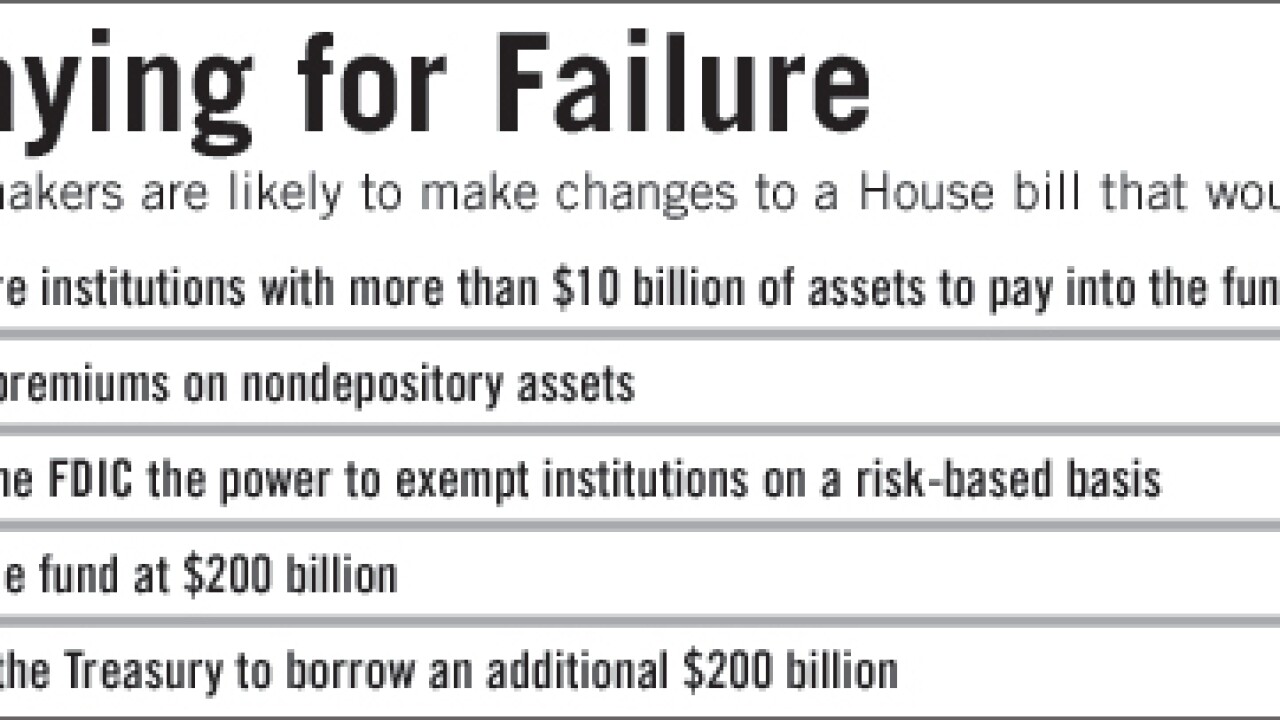
The creation of a fund to pay for the resolution of a systemically important institution is turning into one of the more difficult challenges in the regulatory reform debate.
November 11 -
House Financial Services Committee Chairman Barney Frank said Thursday that he would make major changes in a systemic-risk reform bill before moving to a final vote in two weeks.
November 5 -
WASHINGTON — A House Financial Services Committee vote on a bill to create a systemic-risk regulator is likely to be a long, painful slog, given the myriad unresolved issues still outstanding.
November 3 -
Facing long odds, the Banking Committee Chairman builds support for a plan to create a prudential regulator. But would a single agency kill the dual banking system?
November 1 -
Now that a government program to buy up toxic assets finally appears ready to fly, many observers are wondering if there is any need for it.
November 1 -
WASHINGTON — The federal and state banking regulators on Friday provided guidelines for prudent workouts of troubled commercial real estate loans.
October 30 -
Some daylight emerged Thursday between Treasury Secretary Tim Geithner and House Financial Services Committee Chairman Barney Frank over whether systemically important institutions will be publicly identified.
October 29 -
For all the invective directed at the Federal Reserve Board over the financial crisis, the central bank still emerged as the big winner under draft legislation to rein in systemic risk.
October 28 -
House Financial Services Committee Chairman Barney Frank introduced a revised draft bill late Tuesday that would give the Federal Reserve Board the power to oversee systemically important companies, but beef up a proposed interagency council to advise the central bank.
October 27 -
Under various proposals being weighed in Congress, the Treasury could end up overseeing systemic risk, deciding when the government exercises unprecedented resolution powers over giant companies and gaining veto power over what is now the Fed's free hand to aid failing firms.
October 26 -
President Obama's moves to spur more small-business lending are largely a grab bag of old ideas and minor tweaks that are unlikely to have much impact, observers said.
October 21 -
The Troubled Asset Relief Program still suffers from implementation and transparency inefficiencies, according to a report due today from the program's inspector general.
October 21 -
The principal argument for national preemption — that states would run amok, crafting conflicting rules that would make doing business nationwide impossible — is undercut by recent history.
October 16 -
Bank regulators warned Wednesday of continuing credit- and asset-quality declines, particularly for commercial real estate loans.
October 14 -
President Obama takes on the "Butcher/Baker" argument against the CFPA; Treasury Secretary Tim Geithner's got game?; the MBA beefs up its lobbying shop.
October 9 -
The Treasury Department announced Thursday that it has reached its goal of implementing 500,000 trial loan modifications before November.
October 8 -
The Troubled Asset Relief Program has made strides, but transparency and implementation issues remain, according to a Government Accountability Office report released Thursday.
October 8 -
Rep. Darrell Issa, the lead Republican on the House Oversight and Government Reform Committee, challenged the Treasury Department and Federal Reserve Board to explain government documents that he said proved they were aware of Merrill Lynch's $3.6 billion in bonuses despite claims otherwise.
October 8 -
Many observers said demand for the Public Private Investment Program has dropped off significantly, and will not rebound unless the Treasury can prove there are deals to be had.
October 6 -
In a report to Congress, Inspector General Neil Barofsky said the Treasury labeled all of the initial nine banks to receive Troubled Asset Relief Program funds as "healthy." Yet, Barofsky said the government had concerns at the time over the health of several of those firms.
October 5

