
- Key insight: Consumers are pulling back on big ticket purchases as rising inflation raises concerns about the economic outlook. This is the first decline in the Consumer Confidence Index since the start of the war in Iran.
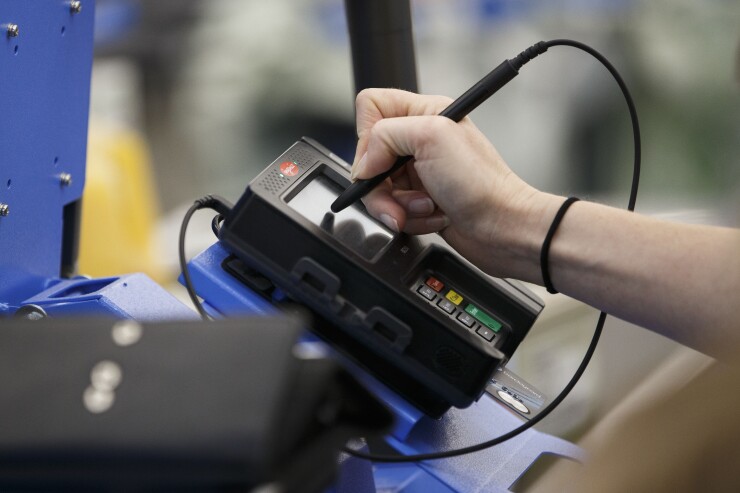 Patrick T. Fallon/Bloomberg
 - Expert quote: "Given the current pricing pressures, we would have expected a more dramatic decline in confidence. However, consumers feel the employment situation will improve by the end of the year." — Jeffrey Roach, Chief Economist, LPL Financial.
- Forward Look: A decline in consumer confidence is often associated with reduced demand for credit and lower overall economic activity. Whether this comes to pass will depend largely on how long the conflict in the Middle East persists and how long it takes for energy prices to recover.

Prolonged conflict in the Middle East could soon lead to a pullback in borrowing, according to a key consumer confidence report released Tuesday.
Two-thirds of consumers said they were reducing spending in response to rising prices, according to the Conference Board's Consumer Confidence Index survey, with many pointing to
"Consumer confidence edged downward in May as the inflationary impacts of the war in the Middle East intensified," said Conference Board Chief Economist Dana M. Peterson in a press release. "Consumer appraisals of current business conditions and the current labor market were moderately less positive compared to last month."
The Consumer Confidence Index index dropped by 0.7 points, from 93.8 to 93.1. It was the first decline in the series this year, which started 2026 at a 12-year low of 84.5 after a steep fall from last December's reading of 94.2 — a collapse driven by concerns over inflation and tariffs. Sentiment had recovered steadily this year, even through the outbreak of the war in Iran at the end of February.
While not directly linked, consumer confidence tends to be strongly correlated with borrowing and the demand for credit, which had been on the rise this year. In March, outstanding consumer credit was up 5.8% year over year, according to data tracked by the Federal Reserve, the highest annualized growth rate since December 2023, when the Consumer Confidence Index was 110.7.
Survey respondents expect prices to rise by 6.2% over the next year, the same as last month but up from 5.5% in February, before the conflict began. The report also showed declining expectations around business conditions, the labor market and income.
As a result of this souring sentiment, most respondents said they were buying fewer items and delaying expensive purchases.
Analysts expect this decline in confidence to slow economic growth. In a note published on the heels of the survey's release, Grace Zwemmer, a U.S. economist for Oxford Economics, said her group is projecting consumption to grow by 1.9% on average this year, down from 2.6% in 2025.
Zwemmer said rising stock prices will bolster the net worths of high-income households, helping them avoid the types of negative wealth effects that would normally limit their ability to borrow and spend. Meanwhile, she said, low-income households are likely to be "hit the hardest" by inflation.
Despite the deterioration of near-term expectations, some analysts and economists say the Conference Board's report still conveys strong underlying confidence in the U.S. economy.
Jeffrey Roach, chief economist for the wealth management firm LPL Financial, pointed to a greater willingness to buy large appliances and a belief among consumers that jobs will be more plentiful in the next six months as positive indicators. He also highlighted the increase in expected travel spending during the second half of the year as a sign that consumers are looking through higher oil prices as a temporary shock.
"Given the current pricing pressures, we would have expected a more dramatic decline in confidence. However, consumers feel the employment situation will improve by the end of the year," Roach wrote in a note Tuesday. "Hence, discretionary spending on items such as travel should increase after the temporary hold on spending. Many who said they are currently delaying purchases of discretionary items, plan to buy them in the next six months."
He added that gross domestic product is likely to fall this year, but could well rebound if the conflict is resolved soon.
Mohamed El-Erian, an economist and former CEO of Pimco, in a post on X, noted that the "relatively low overall" sentiment had not yet translated into "hard economic data such as retail sales."
Other measures of consumer sentiments have been sounding the alarm about spending outlooks and inflation for months. The University of Michigan's Survey of Consumers, another often-cited report, noted a 10% decline in sentiment from April to May and a 14% decline year-over year.
Market-based indications of inflation expectations have been on the rise since the war began. Yields on 10-year Treasury Inflation-Protected Securities, or TIPS, have risen from 1.7% at the end of February to more than 2% at the end of May, peaking at 2.18% last week.
Fed officials have taken notice of these trends. During the Federal Open Market Committee's
Last week, Fed Gov. Christopher Waller said
"Inflation is not headed in the right direction," Waller said. "Based on this recent data, I would support removing the 'easing bias' language in our policy statement to make it clear that a rate cut is no more likely in the future than a rate increase."


