Demographics

  • The alternative credit bureau Pay Rent Build Credit Inc. is using information from the bill payment software company Billeo Inc. to establish credit scores for people with thin or no credit histories.

    March 10
  • The remittance service Bank of New York Mellon Corp. developed for other banks to offer under their own brands is part of an effort to beef up such white-label offerings, particularly those involving small-dollar transactions.

    February 25
  • With global financial markets wavering, Fed interest rates fluctuating, and the subprime mortgage fallout continuing, the health of the world's banks and financial markets dominated discussions at the World Economic Forum's annual meeting in Davos, Switzerland. This year's meeting focused on the concept of "collaborative innovation" and how it may be harnessed to better the everyday lives of people around the world.

    February 8
  • Citigroup Inc.'s acquisition of a remittance outsourcer underscores the company's aspirations to expand its role as a global facilitator of transactions between financial institutions.

    February 7
  • Checkspring Bank, a Bronx, N.Y., start-up that caters to underbanked consumers, is promoting an alternative to refund anticipation loans through a partnership with the financial education nonprofit Ariva Inc.

    February 4
  • Western Union Co. said the difficulties in its U.S.-to-Mexico remittance business have recently been compounded by the housing market bust and a change in immigration patterns.

    February 1
  • The Salt Lake City processor Galileo Systems Inc. says the combination prepaid debit and secured credit card it began marketing last year is so popular that it has outgrown its issuer, MetaBank.

    January 29
  • The year is shaping up to be a tough one for bankers, but how will the subprime mortgage meltdown and the resulting downturn affect the way banks work with the underbanked?

    January 25
  • Georgia

    Once again a hybrid community bank-money services business is operating in the Atlanta area using the name El Banco de Nuestra Communidad.

    January 23
  • The continuing consolidation of the check-cashing industry could lead to changes to pricing, observers said, though they disagreed about which way fees would go.

    January 17
  • MoneyGram International Inc., whose check processing business lost at least $860 million on subprime investments last year, said Tuesday that it plans to restructure the business.

    January 16
  • Eight months after it was introduced, Wal-Mart Stores Inc.'s prepaid debit card appears to be making headway with the underbanked.

    January 15
    20080114vgsjpqvs-1-011508walmart.jpg
  • Despite the jitters felt in the market last week when the Internal Revenue Service said it was contemplating new restrictions on refund-anticipation loans, experts said the rule would not necessarily spell the end of such products.

    January 7
  • Richard C. Breeden, the chairman of H&R Block Inc. who treated the company's thrift like an albatross when he campaigned for a seat on the board this past summer, appears to be softening his stance on the issue.

    December 19
    20071218qa0iczmi-1-121907block.jpg
  • Euronet Worldwide Inc. says its proposed hostile takeover of MoneyGram International Inc. would create a remittance powerhouse, and some analysts concur.

    December 14
    20071213z9we47fv-1-121407money.jpg
  • Western Union Co. said Wednesday that it has introduced a service in nine developing countries that lets Web site publishers using a Google Inc. ad-placement program receive cash payment from advertisers.

    November 29
  • The person-to-person payments company Obopay Inc. has a new tool to reach the underbanked, a market it never intended to pursue.

    November 19
  • A privately funded antipoverty program backed by Mayor Michael Bloomberg is paying underbanked residents of New York to open savings accounts at four banks and four credit unions.

    November 14
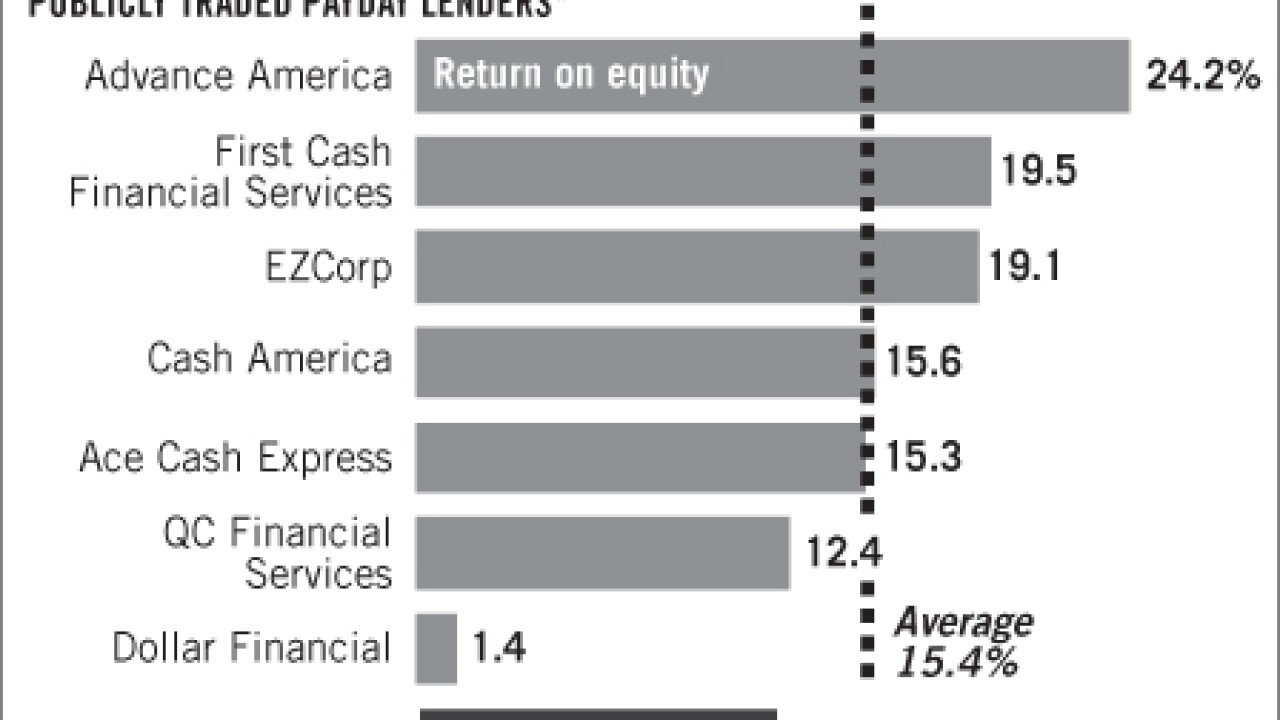
  • Payday lending is on the verge of being outlawed in the District of Columbia, but the fact remains that consumers will still need access to short-term, emergency loans. Credit unions already are marketing what they call lower-cost alternatives to the traditional payday loans, and consumer finance firms offer products that could be attractive to consumers who have used payday lenders. Even bankers, with a nudge from the Federal Deposit Insurance Corp., might consider getting in on the action. The D.C. City Council passed the Payday Loan Consumer Protection Act of 2007 in September, and Mayor Adrian Fenty, a Democrat, signed it last month. The bill, which would cap the annual percentage rate on payday loans at 24%, is in Congress’ hands now. If approved, it would likely go into effect by Jan. 8. Payday lenders have said the caps would make it impossible for them to make loans profitably and likely would force them to stop lending in Washington. Ultimately, they argue, consumers would suffer, because they would have fewer options for short-term, small-dollar loans. But Mary Cheh, the city councilwoman who sponsored the legislation, said in interview with American Banker shortly before the bill was passed that she was confident “the void will be filled” by the likes of finance companies and credit unions. The District of Columbia would join 13 other jurisdictions that have either banned payday lending or capped rates on the loans, essentially forcing payday lenders out. North Carolina was one of the first to ban it, in 2001, though for years many lenders were able to get around the law by entering rent-a-charter agreements with out-of-state banks. It took Attorney General Roy Cooper five years of investigations and lawsuits — not to mention a crackdown on charter renting by federal regulators — to force out all of the state’s payday lenders. Sharon Reuss, a spokeswoman for the Center for Responsible Lending, a consumer watchdog group in Durham, N.C., said the disappearance of payday lenders has saved the state’s residents $150 million a year in fees and interest payments. Alternative loan products, specifically the State Employees Credit Union Salary Advance Loan, have emerged to meet residents’ need for emergency cash, she said. The credit union began exploring small-dollar loans after an August 2000 survey found that many of its members, made up of state and public school employees and their families, had been borrowing from payday lenders. Most could not qualify for conventional loans, because of spotty credit reports and high debt-to-income ratios. “We were trying to figure out why in the world our members were using payday lenders,” said Leigh Brady, the credit union’s senior vice president of education services. “We needed something to get them away from the payday lenders.” A program the credit union began in 2001 lets members take out salary advance loans with a maximum of $500, a minimum of $50, an APR below 18%, and no fees. Every time a loan is granted, 5% of the advance is deposited into a cash account and accumulates interest at the passbook rate. The money is used to securitize the loan, as well as to encourage members to save. “The savings is the best feature of the whole program, because it helps to break the cycle of debt,” Ms. Brady said. Currently, 50,000 members of the credit union use the program. A typical payday lender charges a fee of $15 for every $100 borrowed, but the interest on a $500 salary-advance loan from SECU is $5. The Community Financial Services Association, a trade group for payday lenders, said credit unions cannot make small-dollar loans profitably. “Some credit unions and good will industries are offering payday advances and charging $10 per $100 and losing money,” said Steven Schlein, a spokesman for the group. “It’s not working for them, because the right price for a payday loan is between $15 and $17.” Credit unions “don’t have to pay taxes because they are nonprofit, but they still can’t get away with going that low.” There are 49 payday-lending outlets in Washington, and it is likely that some, if not all, would pull up stakes when the rate caps take effect. In anticipation of that, a coalition of credit unions is marketing Stretch Pay, a $250 or $500 revolving line of credit for which borrowers pay an annual fee of $35 or $70. Customers must repay the loan within 30 days before another advance can be taken. “Credit unions have always been the best option for consumers to get loans, because of their low rates,” said Jennifer Gore, the chief advocacy officer for the Maryland and D.C. Credit Union Association. “At credit unions, we believe that consumers should end up better off, rather than worse off, after getting a loan.” Yasuko Fumoro, a spokeswoman for Microfinance International Corp., a Washington consumer lender that targets the unbanked or the underbanked, particularly Hispanic immigrants, said it offers a consumer product that could be an option for the city’s residents. The loan carries an interest rate of 24% and ranges in size from $500 to $3,000. The biggest difference between its loans and payday loans is that consumers repay them in installments, as they would car or home loans, Ms. Fumoro said. Banks that are based in or do business in Washington could also step in, with encouragement from regulators. The FDIC is taking applications for its Small Dollar Loan program, a two-year test to encourage banks of all sizes to offer payday loan alternatives. So far the FDIC is talking to 57 banks, with $40 million to more than $100 billion of assets, and a Washington bank could very well join that group.

    November 7
    200711062bixr1yl-1-110707payday.jpg
  • Two developments in payment systems could make it easier for consumers to make their rent or mortgage payments electronically, while streamlining payment processing for property managers and mortgage banks.

    September 14