
Federal Reserve
Federal Reserve


-

Sens. Sherrod Brown and Elizabeth Warren criticized Federal Reserve Chair Jerome Powell over reg relief policies instituted by the central bank, signaling that some progressive lawmakers may be reluctant to give him a second term.
July 15 -
 AB - Policy & Regulation
As the Federal Reserve mulls whether to establish its own digital currency, Chair Jerome Powell told lawmakers that cryptocurrencies designed to have the stability of bank deposits and money market funds should be regulated accordingly.
July 14 -

Fiscal restraint, the reversal of enormous amounts of monetary stimulus, smarter regulation and job retraining are among the public policy steps that could interrupt the long U.S. tradition of boom-and-bust cycles.
July 14 -

The president has a chance to make his mark on the central bank as the terms of Federal Reserve Chair Jerome Powell and Vice Chair of Supervision Randal Quarles near their end. He will face pressure from progressives to pick reform-minded leaders, while moderate Democrats and Republicans in the narrowly divided Senate might favor reappointing Powell.
July 14 -

Fintech companies with narrow-purpose banking charters pose a safety-and-soundness risk and should be denied access to the payment system and other perks unless they meet the same strict regulatory criteria as traditional financial institutions, trade groups for banks and credit unions told the Federal Reserve.
July 12 -

Edward Al-Hussainy, senior interest rate and currency analyst at Columbia Threadneedle, will discuss the economy, inflation and the Federal Reserve.
-

Fed Vice Chairman for Supervision Randal Quarles says the benefits of a central bank digital currency are “unclear,” and that a digital dollar could actually “pose significant and concrete risks.”
June 28 -

Some of the 23 large banks that participated in last week’s stress tests will be better positioned to reward shareholders than others, since they padded their capital amid the pandemic. Still, all are expected to tread cautiously amid ongoing economic uncertainty.
June 28 -

The Federal Reserve found that under its harshest stress-test scenario, bank capital ratios would decline to 10.6% on average — well above the 4.5% minimum requirement. Restrictions imposed on dividend payments and share repurchases during the economic crisis last year will be lifted after June 30.
June 24 -
The House Financial Services Committee passed a bill along party lines to require global systemically important banks to submit new annual reports on activities to the Fed.
June 23 -

The biggest U.S. banks, led by JPMorgan Chase and Bank of America, are expected to pay out $142 billion in capital to shareholders after clearing this year’s stress tests.
June 23 -

No-fee digital bank accounts subsidized by the Federal Reserve would help community banks draw in new customers and pay for technology upgrades, proponents of the idea say. But it's a hard sell to executives skeptical of government involvement in retail banking.
June 23 -

The huge buffers that banks built up over the pandemic are protecting the financial system from looming threats, regulators told President Biden during a meeting that also touched on climate change, extension of credit to the underserved and other topics.
June 22 -
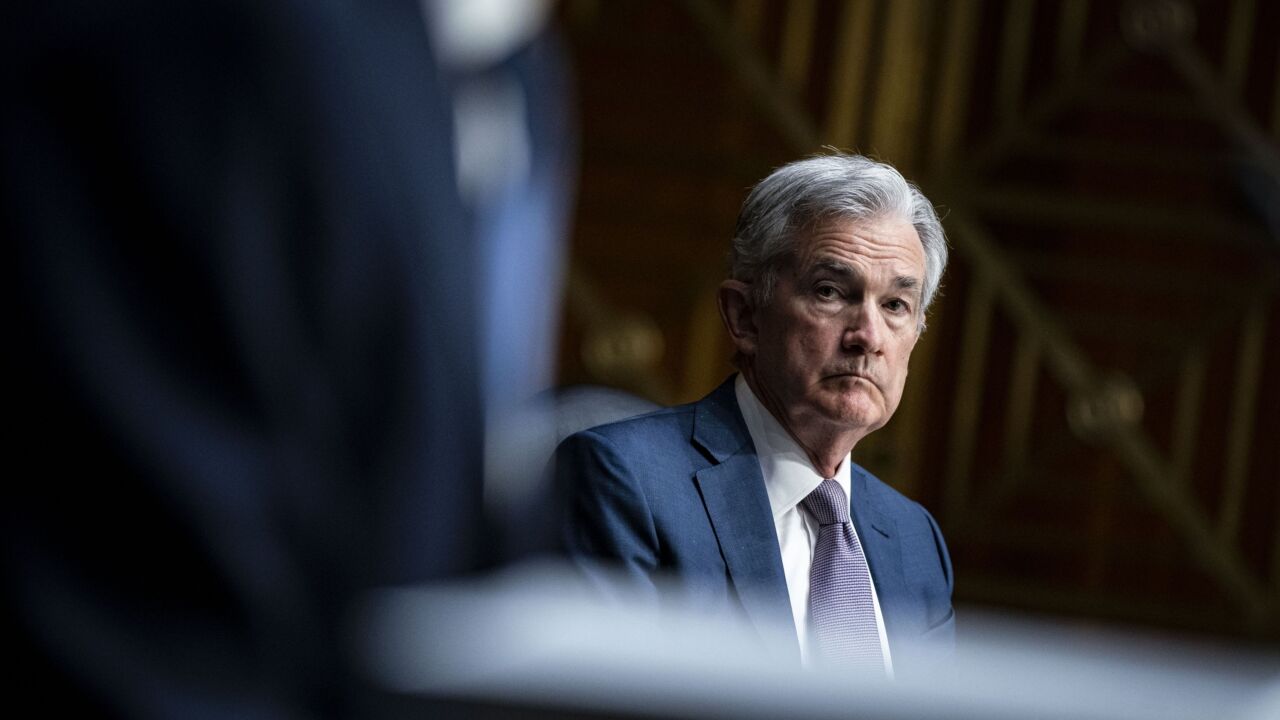
Federal Reserve Chairman Jerome Powell said the market dislocations of the past year resulting from the pandemic had changed the impact that the supplementary leverage ratio was having on the largest banks. After temporarily easing the requirement, the central bank is considering longer-term reforms.
June 16 -

Federal Reserve officials held interest rates near zero while signaling they expect two increases by the end of 2023, pulling forward the date of liftoff and projecting a faster-than-anticipated pace of tightening as the economy recovers.
June 16 -

By 2023, the Federal Reserve expects to launch a service that would allow businesses and consumers to complete payments in real time. But a digital currency it's now studying could have similar benefits — while potentially removing the need for bank intermediaries.
June 15 -

Randal Quarles, the Federal Reserve's vice chair for supervision, says the central bank was wise not to require banks to build capital cushions in the lead-up to the pandemic. But that decision rested on a misleading a narrative and could wind up threatening the economic recovery.
June 14 -

The appointments of former senior leaders from a rival regulator could force the Office of the Comptroller of the Currency to embrace interagency cooperation after taking a go-it-alone approach during the Trump administration, some observers say. Others worry about another extreme: the Federal Reserve having outsize influence over financial policy.
June 11 -

The Federal Reserve has signaled the need for congressional authorization if the central bank moves ahead with creating a digital currency. But senators raised questions at a hearing about whether it would help consumers, how it would complement private-sector banking and other issues.
June 9 -

Nineteen of the nation's largest banks plus four smaller firms will be tested against baseline and severely adverse economic scenarios. The central bank will release details on their performance on June 24.
June 7


