-
Deferrals may be hiding credit issues, leading lenders to track deposit flows, property maintenance and other factors to gauge the true health of their portfolios.
October 8
-
Bank of America plans to offer some of its customers access to short-term loans, the latest blow to the payday lending industry.
October 8
-
The company, which provides credit cards to millennials, is expanding its target audience beyond thin-file consumers and those without credit histories. It will now also target those with blemished, nonprime credit histories.
 October 7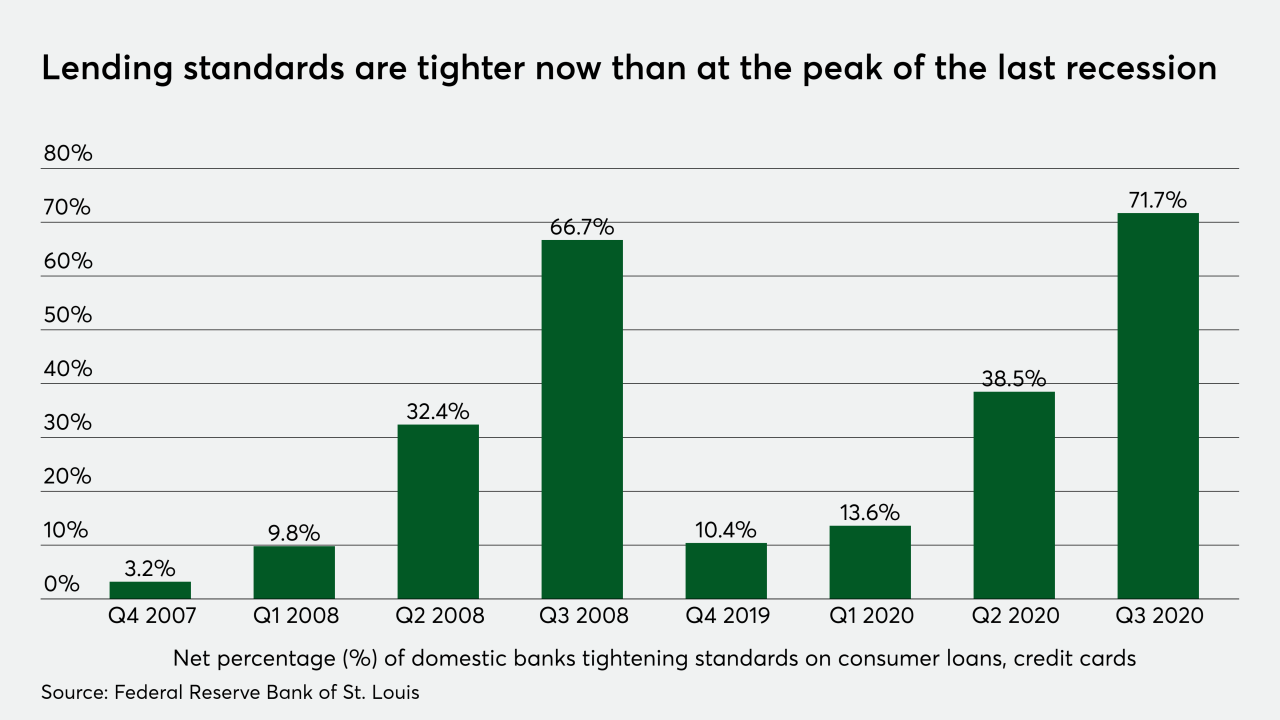
-
Millennial credit card provider Petal is expanding its target audience beyond thin-file consumers and those without credit histories. It will now also target those with blemished, non-prime credit histories.
October 7 -
Low rates and intense competition might lead some banks to ease underwriting standards in 2021, when the economy may not yet have recovered.
October 5
-
House forgiveness plan for Paycheck Protection Program loans is better than nothing, bankers say; why some banks still lean on mainframes; what's next for Goldman Sachs's Marcus; and more from this week's most-read stories.
October 2
-
Harvest, a fintech founded by Nami Baral, has developed an alternative scoring method that amasses data on spending patterns, debt payments and even earnings potential to get a better sense of consumers' creditworthiness.
 October 1
-
The optometrist Benjamin Thayil offers an alternative form of financing for consumers who may be wary of large credit card bills or shocked at the idea of paying for an entire eye treatment all at once.
 October 1
-
Commercial real estate loans are vulnerable as financial assistance for tenants winds down and might not be fully renewed. Late rent payments could rise, leading lenders to press landlords to pay up.
September 23
-
-
Credit unions need to improve their processes to ensure the problems that have arisen with credit reporting during the coronavirus don't happen again.
September 22 LendEDU
 -
Originations in the third quarter are on pace to double what the Detroit lender reported a quarter earlier, adding more high-yielding loans to the balance sheet.
 September 15
-
Klarna AB, a Swedish payment provider for online shoppers, is still setting its sights on an initial public offering even after its latest funding round left it roughly twice as valuable as it was a year ago.
September 15
-
The performance of about $3 billion in hotel and other loans flagged by the Dallas company as high-risk has been a "a pleasant surprise," its chief credit officer said at an industry conference.
September 14
-
More consumer and commercial borrowers are paying their loans, increasing the likelihood that charge-offs will be manageable for banks despite the ongoing pandemic.
September 11
-
There is a war brewing in the buy now, pay later (BNPL) market, and Mastercard is working with TSYS to bring in a slew of new players — credit card firms.
September 2
-
Florida and West Virginia recently joined four other states in setting up regulatory sandboxes that allow startups to test products with consumers without obtaining a license.
 August 26
-
Afterpay has entered into an agreement with NBQ Corporate SLU to acquire Pagantis SAU and PMT Technology SLU for €50 million (about $59 million) to expand into France, Italy and Spain — a direct challenge to Klarna, one of the dominant European buy now, pay later (BNPL) providers.
August 25
-
Brisbane, Australia-based EML has partnered with the New Zealand buy now, pay later fintech Laybuy to leverage digital cards for in-store and online retail purchases.
August 24 -
Part of the coronavirus’s economic story is the sudden boom in installment payment services — a sure sign of consumers and merchants wanting a haven from revolving debt. But the rush to simpler credit is also a reflection of how the crisis has changed the way people are living and managing their lives.
August 24


