-
Deutsche Bank says it’s on track to meet its financial targets while Commerzbank's top two executives resign; recent Fed stress test results show European banks' poor performance in U.S. continues.
July 6
-
Six of the eight regional banks that announced their stress capital buffers on Tuesday said they will need just a 2.5% cushion to weather an economic downturn. All eight said they’ll keep their dividends steady.
June 30
-
In response to the Federal Reserve's stress tests, Wells said it will lower its third-quarter distribution to shareholders. Meanwhile, JPMorgan Chase, Goldman Sachs and five other companies announced stress test capital buffers that exceed the minimum requirement.
June 29
-
Some observers said the central bank should have suspended dividends entirely in response to an unprecedented economic emergency caused by the pandemic. Others said its more cautious moves were appropriate because big banks' capital is strong and the economy could bounce back.
June 26
-
The Fed stopped short of banning payouts entirely following bank stress tests; banks get greater freedom to invest in venture capital funds and reduced collateral on swap trades.
June 26
-
In the most sweeping capital distribution order since the financial crisis, the Federal Reserve says it will prohibit big banks from buying back their stock in the third quarter and limit dividend payments to second-quarter levels.
June 25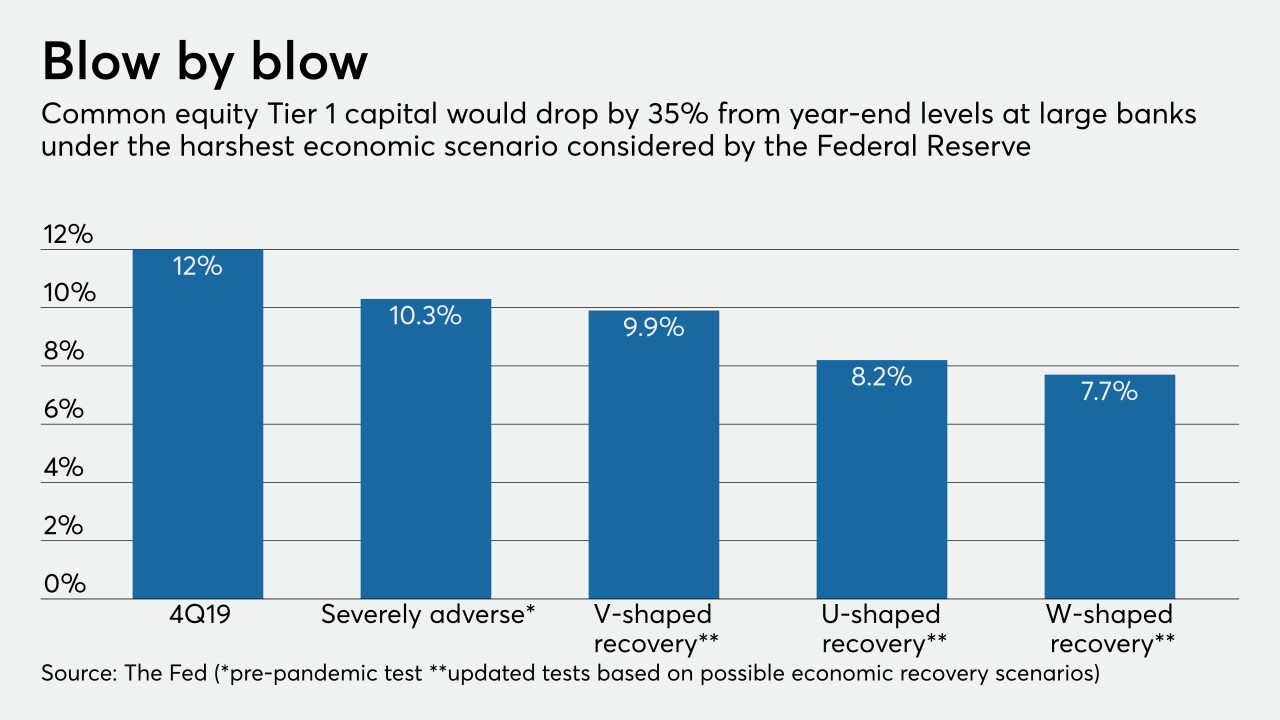
-
Borrower relief is necessary in a national emergency, but if the exclusion of the deferred loans from troubled-debt restructurings is extended past the end of the year, safety and soundness could be compromised.
June 25
-
The embattled German payments company filed for insolvency, while its former COO is either on the run or looking for the missing $2 billion; the giant asset manager is looking to hire more college graduates rather than poach junior bankers.
June 25
-
The lawmakers argued in a letter to the Federal Reserve that suspending dividend payouts would be the "prudent course of action," allowing banks to build their capital cushions and continue lending during the coronavirus pandemic.
 June 24
-
Business continuity plans should be used constantly, not just when the crisis is at its peak, says the New York Fed’s head of financial services.
June 24 The Federal Reserve Bank of New York
 -
Big banks will need to show how well they can withstand three different scenarios before they can pay dividends; the German payments company is still looking for $2 billion of missing funds.
June 22
-
The senior official said the Federal Reserve’s gauge of a firm’s performance under economic recovery scenarios will affect decisions about its capital distribution, but individual results of the analysis will not be made public.
June 19
-
Unlike in previous years, the results from two different evaluations will be released simultaneously and will include an assessment of bank capital under coronavirus-related scenarios.
June 9
-
The takeaway from the PPP rollout is that bankers must protect their reputations and limit their risk appetites as they participate in further government-backed rescue programs.
May 29
-
The general structure of this year’s reviews is unchanged despite the pandemic. But a supplemental analysis of banks' response to the downturn could weigh heavily in evaluating 2020 capital distributions and making adjustments to the tests over the long run.
May 28
-
Payouts continue to be relatively generous, but that could change if the Federal Reserve demands banks bolster capital or the economy worsens.
 May 28
-
The Federal Reserve also said in a supervisory report released Friday that it would conduct stress tests this quarter as planned, taking into account sudden deterioration in the economy brought on by the coronavirus pandemic.
May 8
-
The agency's top supervisory official said the Comprehensive Capital Analysis and Review will proceed on schedule, and signaled that the Fed will look at how institutions are responding to fallout from the coronavirus.
April 13
-
Q1 profits expected to drop by nearly 25%, while investment banking revenues could tank much more; many banks have tighter standards than the SBA.
April 13
-
OakNorth helps banks analyze credit, identify pandemic-related risks and forecast borrower issues before they turn into defaults.
 April 8


