
Federal Reserve
Federal Reserve


-

The Fed has already eased certain capital requirements in response to the coronavirus pandemic. It should avoid making any further adjustments to the surcharge, which is meant to keep global banks from creating systemic risks.
July 10 -
Many big banks say they will focus on existing customers in offering credit through the Federal Reserve’s emergency lending program for midsize businesses. Complex vetting and fear of being inundated are said to be among their concerns.
July 9 -

Randal Quarles, who is also chairman of the Financial Stability Board, said FSB members must do more to prepare for bank failures.
July 7 -

The Main Street Lending Program and other Federal Reserve loan facilities should be tailored to the needs of Black-owned banks and businesses.
July 7 -

Banks participating in the Main Street Lending Program were able to register for and offer credit to businesses last month, but the Federal Reserve said Monday it was set to make the effort fully operational.
July 6 -

The Main Street Lending Program is off to a slow start, while the PPP is extended five weeks to distribute the remaining $130 billion in loans; the European regulator is softening its stance to allow more deals.
July 2 -

Federal Reserve Chairman Jerome Powell said about 300 lenders have signed on to the program and that the central bank is committed to making adjustments that could attract more borrowers.
June 30 -
Six of the eight regional banks that announced their stress capital buffers on Tuesday said they will need just a 2.5% cushion to weather an economic downturn. All eight said they’ll keep their dividends steady.
June 30 -

In response to the Federal Reserve's stress tests, Wells said it will lower its third-quarter distribution to shareholders. Meanwhile, JPMorgan Chase, Goldman Sachs and five other companies announced stress test capital buffers that exceed the minimum requirement.
June 29 -

Some observers said the central bank should have suspended dividends entirely in response to an unprecedented economic emergency caused by the pandemic. Others said its more cautious moves were appropriate because big banks' capital is strong and the economy could bounce back.
June 26 -

Wells Fargo customers targeted with phishing attacks using calendar invites; Fed freezes stock buybacks, caps dividends after stress test results; Citigroup names Titi Cole its head of global operations and fraud prevention.
June 26 -
A recent blog post argues that the industry must get ready for the possibility of the Federal Reserve lowering rates below zero.
June 26 -

The Fed stopped short of banning payouts entirely following bank stress tests; banks get greater freedom to invest in venture capital funds and reduced collateral on swap trades.
June 26 -
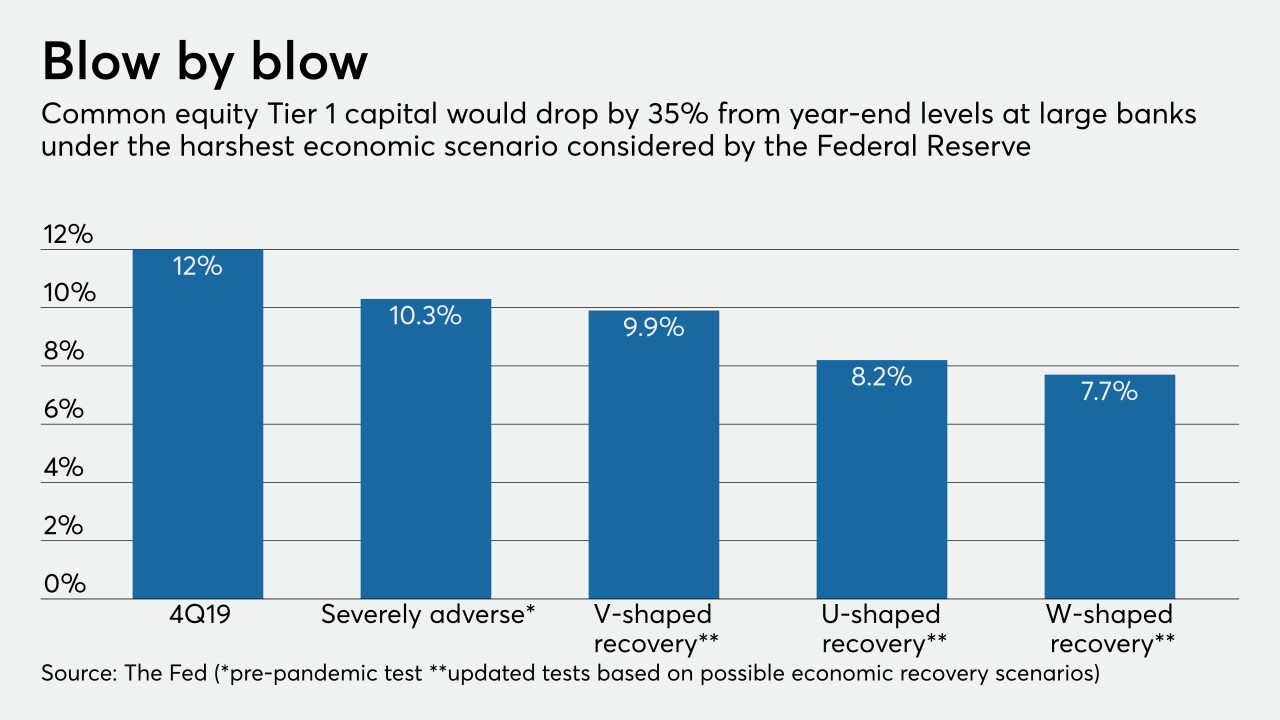
In the most sweeping capital distribution order since the financial crisis, the Federal Reserve says it will prohibit big banks from buying back their stock in the third quarter and limit dividend payments to second-quarter levels.
June 25 -

Five financial regulatory agencies clarified the meaning of "covered funds" under the Volcker Rule. Meanwhile, the FDIC gave certain banks more flexibility in interaffiliate exchanges of swaps and adopted a workaround of a court decision governing interest rates on loans sold across state lines.
June 25 -

The embattled German payments company filed for insolvency, while its former COO is either on the run or looking for the missing $2 billion; the giant asset manager is looking to hire more college graduates rather than poach junior bankers.
June 25 -

The lawmakers argued in a letter to the Federal Reserve that suspending dividend payouts would be the "prudent course of action," allowing banks to build their capital cushions and continue lending during the coronavirus pandemic.
June 24 -

The payments company is buying Finicity, which powers platforms for Rocket Mortgage and others; the small N.J.-based lender to fintechs is the fourth largest PPP provider.
June 24 -

Participation in the Main Street Lending Program for midsize companies is partly about public service, but the core business rationale is building "a banking relationship that continues on for some time," the Boston Fed chief says.
June 23 -

Sens. Sherrod Brown and Elizabeth Warren are asking three federal agencies to reverse changes that allow banks to exclude certain items from their supplementary leverage ratio.
June 22


