
Regulation and compliance
Regulation


-

Scott Turner, President Trump's pick to head the U.S. Department of Housing and Urban Development, faced opposition from Democrats on the Senate Banking Committee, but his nomination was nonetheless approved by a vote of 13-11.
January 23 -

The Consumer Financial Protection Bureau found that auto lenders' use of reposession agents spiked to nearly 70% in 2022, up from 31% in 2018, resulting in higher costs for consumers.
January 23 -

The era of unchecked AI enthusiasm is giving way to a more measured and deliberate approach. Organizations are beginning to see AI not as a panacea but as a powerful, albeit complex, tool that requires thoughtful implementation.
January 23 -

House Republicans are in talks over raising the cap for state and local tax deductions after winning pledges to include it in a must-pass tax bill this year.
January 23 -

The president has signed dozens of executive orders touching a wide range of government functions, but banking policy has largely gone untouched — so far.
January 23 -

Hester Peirce and SEC Acting Chair Mark Uyeda say they want to group to devise a clear compliance framework for digital assets and end regulation by enforcement.
January 22 -

China currently dominates the market for the hardware and software used to mine cryptocurrency. Creating a large federal reserve would expose a major U.S. asset to potential Chinese meddling.
January 22 -

Senate Republicans would like to do a large bill on immigration and energy first and then tackle tax reform in a second bill. House Republicans prefer one large bill.
January 22 -

Fees falling outside of tolerances cost the industry more than $1 million per 1,000 loans, according to an ICE Mortgage Technology study from earlier this year.
January 22 -

The avalanche of cases announced Friday included charges against a no-longer registered advisor and firm accused of misappropriating more than $20 million from clients.
January 21 -

Trump's pick for treasury secretary commits to a thorough and careful recapitalization and release process for Fannie Mae and Freddie Mac.
January 21 -

President Trump reinstated a revised executive order from his first term that would make it easier for the White House to remove policy-facing federal employees — including Senior Executive Service employees. The National Treasury Employees Union sued the White House in response.
January 21 -

The Federal Deposit Insurance Corp.'s newly installed Acting Chairman Travis Hill issued a statement laying out his priorities for the agency, including reviewing and repealing Biden-era bank regulations, a softer approach to fintech and crypto and addressing so-called debanking.
January 21 -

Industry players, regulators and law enforcement will need to work together in 2025 to ensure that as Americans increasingly rely on digital payments, the fraudsters trying to take advantage of them are kept at bay.
January 21 -

Sunsetting the federal oversight of Fannie Mae and Freddie Mac could ease the cost of renewing President Trump's 2017 tax act, but doing so is an uphill battle.
January 21 -

Federal Deposit Insurance Corp. Vice Chair Travis Hill has assumed the duties of FDIC chair, National Credit Union Administration Vice Chair Kyle Hauptman took over as NCUA chair and Securities and Exchange Commission member Mark Uyeda will serve as acting chair of the SEC.
January 20 -

Some reforms to the system might be necessary, but it would be unwise to eliminate a critical source of funding for banks across the country.
January 20 -

A one-page outline of priorities for Trump's inauguration day obtained American Banker includes financial policy items, including firing Consumer Financial Protection Bureau Director Rohit Chopra, issuing a "reset" of that agency and designating crypto as a "national priority."
January 20 -
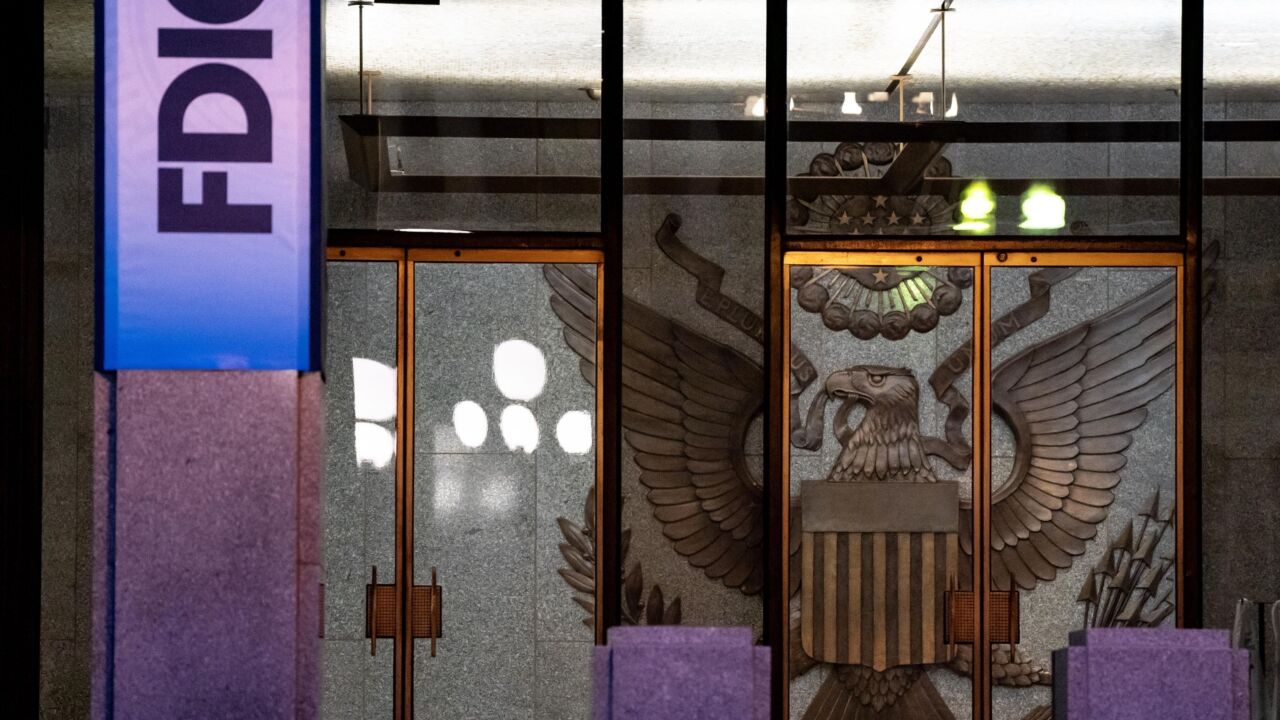
The Chicago-based bank, which failed Friday in the first bank failure of 2025, caused a $28.5 million hit to the Deposit Insurance Fund. The FDIC was appointed receiver and Millennium Bank will assume all deposits.
January 17 -

Citing concerns about going outside its statutory mandate, the Federal Reserve Board of Governors voted to leave the Network of Central Banks and Supervisors for Greening the Financial System.
January 17


