-
Millions of dollars spent on software upgrades are worth the hit to short-term profits, executives at the Buffalo bank said, because it will be able to run deeper credit profiles of borrowers.
 April 24
 -
As horrifying cyberattack scenarios grow more plausible, an American Bankers Association simulation of a hypothetical breach at a $10 billion-asset bank is designed to guide institutions through a set of crisis response steps.
 April 24
 - New York
First Niagara Financial Group in Buffalo, N.Y., said its first-quarter profit declined because of costs tied to its technology upgrade and lower spread income.
April 24 -
American Banker readers share their views on the most pressing banking topics of the week. Comments are excerpted from reader response sections of AmericanBanker.com articles and from our social media platforms.
April 24
-
House lawmakers approved two bills this week to foster greater information sharing between the private sector and government about cyber threats and all eyes now turn to the Senate to see if legislation can finally be enacted.
 April 23
 -
Cybercriminals' distributed denial of service exploits are getting more targeted and sophisticated.
 April 23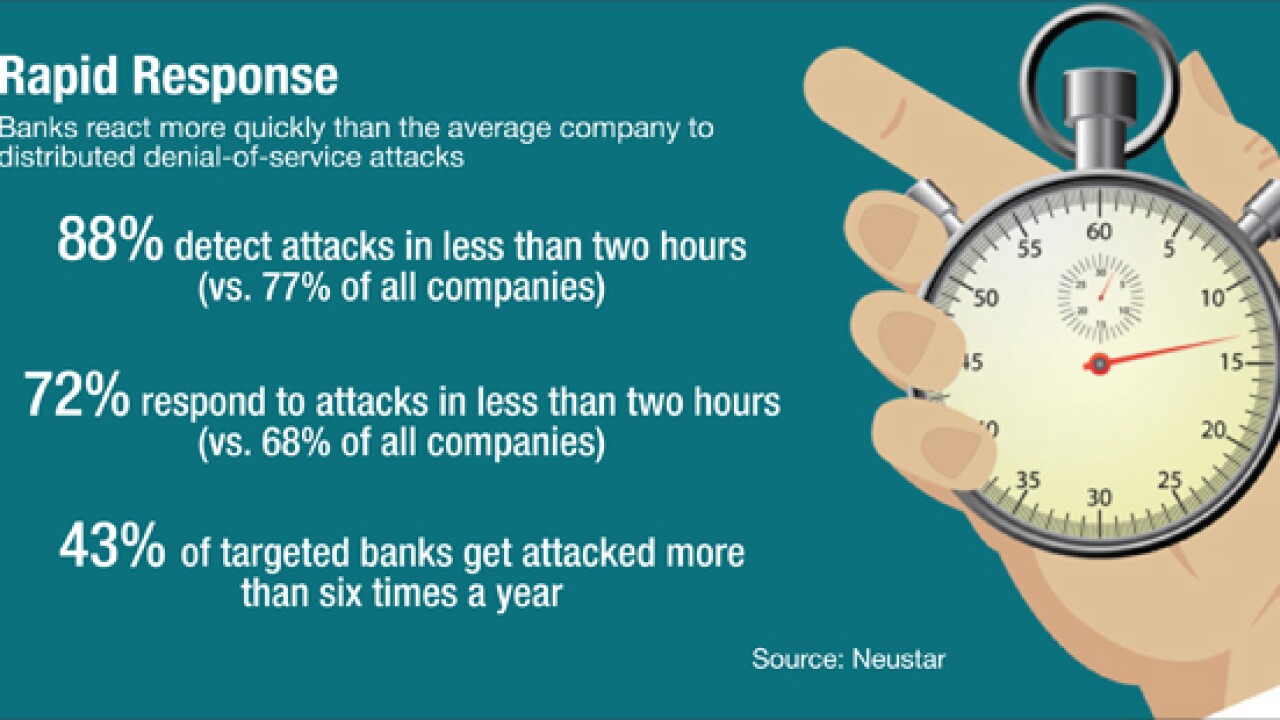
-
Banks that use biometric technology should remember to take client and employee privacy concerns seriously. After all, banks have a duty to protect personal information and prevent its potential misuse.
April 23
-
Small-business lender Funding Circle, which has operations in the United States and the United Kingdom, has received $150 million in new investment.
April 22 -
The San Francisco bank has added three more young technology firms to its accelerator program, which is aimed at adapting products from outside the financial services world for creative uses in banking.
April 22 -
The House is preparing to vote on two cybersecurity bills this week, kicking off the latest push to improve information sharing between private companies and the government about potential attacks and threats.
April 22 -
Jeffrey Robinson, author of the acerbic "BitCon," explains how he squares his admiration for blockchain technology with his contempt for the Bitcoin currency and community in the final part of a conversation with American Banker's Marc Hochstein.
April 22
-
International payments provider Currency Cloud has opened offices in New York, bringing the company into the U.S. market.
 April 21
 -
Customers are dodging deposit fees by hanging onto their extra cash and using apps to more frequently check their balances, denying banks crucial noninterest income.
April 21 -
Global Debt Registry, which has created a central repository for consumer debt, has inked a marketing deal with TransUnion and may extend its reach to payday loans.
April 21 -
Uber Technologies Inc. and Capital One Financial Corp. have joined to give the credit-card issuer's customers cheaper rides on the car-sharing service.
April 21 -
Rand Paul, the Kentucky senator and Republican presidential candidate, told supporters and Bitcoin enthusiasts that policymakers should foster the development of new payments technologies like they did with the Internet.
April 21 -
Consumers should receive the same level of protection whether they choose to do business with a bank or with marketplace lenders and other challengers.
April 21 -
Google will provide deposit insurance backing for funds stored with its wallet service, positioning the technology giant along with stored-value providers that use the FDIC's "pass-through" coverage. Here's why that matters.
April 20 -
Google Wallet is making a significant change in how it handles funds, in the latest of a series of moves that gives Google a stronger footing against Apple Pay's rising tide.
 April 20
 -
As branch transactions continue to decline, banks are increasingly requiring expertise in an area they paid less attention to in the past: digital design. BBVA and Capital One's recent purchases of user-experience and design firms underscore the increasingly important trend.
 April 20


