-
Unbanked consumers generate over $100 billion in annual revenue for alternative financial providers. New studies suggest that banks are well positioned to capture some of that revenue.
February 24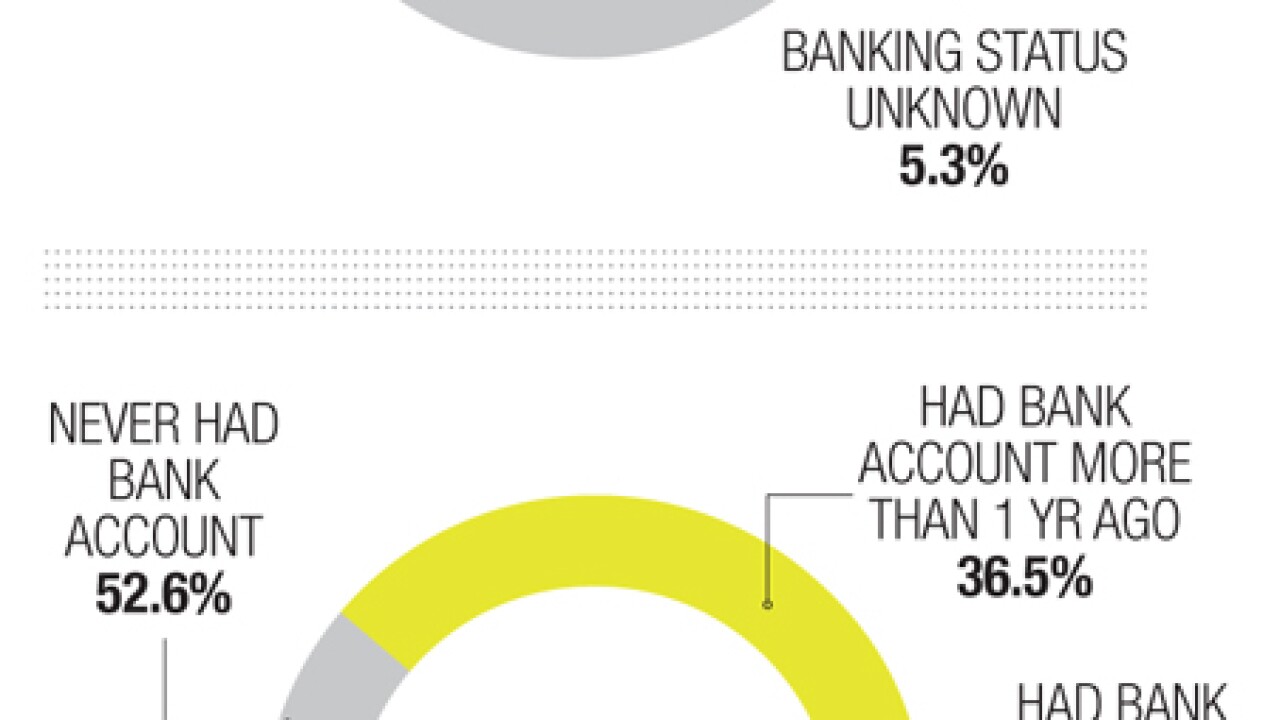
-
Banks want to make loans to people with scant credit histories, but the challenge is figuring out how to do so safely. One possible solution is to look at alternative data. Eager to book more loan business, more and more banks are considering such factors as rent payments, purchasing patterns, even an applicant's spelling to help predict creditworthiness.
February 24
-
Most millennials do almost all of their other business on a portable device, so they want to have this same functionality when buying a home.
 February 23
 -
Like a number of startups and "neobanks" that have sprouted up to challenge incumbent retail banks, Fidor Bank is positioning itself as a more consumer-friendly, tech-savvy alternative.
 February 23
 -
The business analytics software firm SAS has formed a new division focused on risk research and quantitative solutions for financial services firms. Its headed by former bank executive Troy Haines, according to an announcement Monday.
 February 23
 -
Responding to reports last week that its encryption keys had been stolen by U.S. and British spies five years ago, Gemalto contends its products are secure and announced it would reveal results of its investigation into the claims at a press conference Feb. 25 in Paris.
 February 23
 -
Bitcoin's premise is that an open-source computer protocol could support a new global currency, without reliance on the centralized power of banks and governments. But trusting a computer protocol, without human governance, doesn't make sense. As it stands, bitcoin's governance has a long ways to go before institutions would rely on this innovative but flawed currency as a store of value.
February 23
-
-
Gemalto, which manufactures SIM cards and EMV chips, is investigating a report that U.S. and U.K. spy agencies hacked into the company's network and stole mobile phone encryption keys, a technology also used to secure card data.
February 20 -
Gemalto NV, the largest maker of mobile- phone cards, said it's investigating a report that U.S. and U.K. spies allegedly hacked into its computer network to steal the keys used to encrypt conversations, messages and data traffic.
February 20 -
At least two financial services groups say none of their U.S. bank members have reported the existence of Carbanak malware in their networks, suggesting the threat may not be significant.
 February 19
 -
Anthony DeChellis, the former head of Credit Suisse's Private Banking Americas division, has been named president of Jerusalem-based crowdfunding startup OurCrowd.
February 19 -
Credible Labs in San Francisco has completed a round of seed financing that it says will fuel further growth of its student loan refinancing business.
February 19 -
Banks' business models are even more vulnerable to a massive shake-up than industry behemoths like McDonalds and Coca-Cola. The industry will be redefined by technological change and shifting consumer preferences, as well as by regulations that limit the sector's adaptability.
February 19 -
A U.S. probe into how Morgan Stanley client information ended up for sale on the Internet is examining whether a financial adviser was targeted by hackers after he took data from the bank, two people briefed on the inquiry said.
February 19 -
Pay.gov, the federal government's web portal for collecting payments to federal agencies, is now offering PayPal and Dwolla as payment options.
 February 18
 -
Veteran retail banking executive Deanna Oppenheimer has joined the mobile identity-authentication vendor Finsphere as a strategic adviser.
February 18 -
Orrstown Bank in Pennsylvania has introduced two-way text messaging between customers and its service agents. It's the latest effort in the banking industry to make communication easier for mobile-first customers.
 February 18
 -
Decisions about when and how to implement EMV technology in credit and debit cards are difficult. Many banks have decided to slowly phase it in, despite the fact the delay will open them up to greater potential liability.
 February 18
-
Vladimir Drinkman, a Muscovite charged in the biggest data-breach prosecution in U.S. history, pleaded not guilty to federal charges that he conspired to steal 160 million credit card numbers.
February 18


