
Regulation and compliance
Regulation


-

Despite a generally positive picture in the Shared National Credit report, regulators warned that underperforming loans in the portfolio remain elevated.
January 25 -

In 2017, the National Credit Union Administration board approved provisions to make mergers more transparent. But one of those changes has become a casualty of the government closure.
January 25 -

The leaders of the biggest U.S. banks are likely to be summoned to face questions from the Financial Services Committee, an early sign that the financial industry will endure tougher scrutiny under a Democratic-controlled House.
January 25 -

In recent years, new machine learning algorithms and big data have reduced fraud losses to an extent — however, their impact has been relatively limited, in part because the industry has been reluctant to use them. But the use of such technology is soon likely to become far more widespread in the U.K., and across the EU.
January 25 -

With SBA lending at a standstill, many small businesses can't access the capital they need to create and retain jobs, Stephen Steinour says.
January 24 -

Three groups in North Carolina have scrapped plans to start banks because of difficulty raising capital, among other reasons.
January 24 -
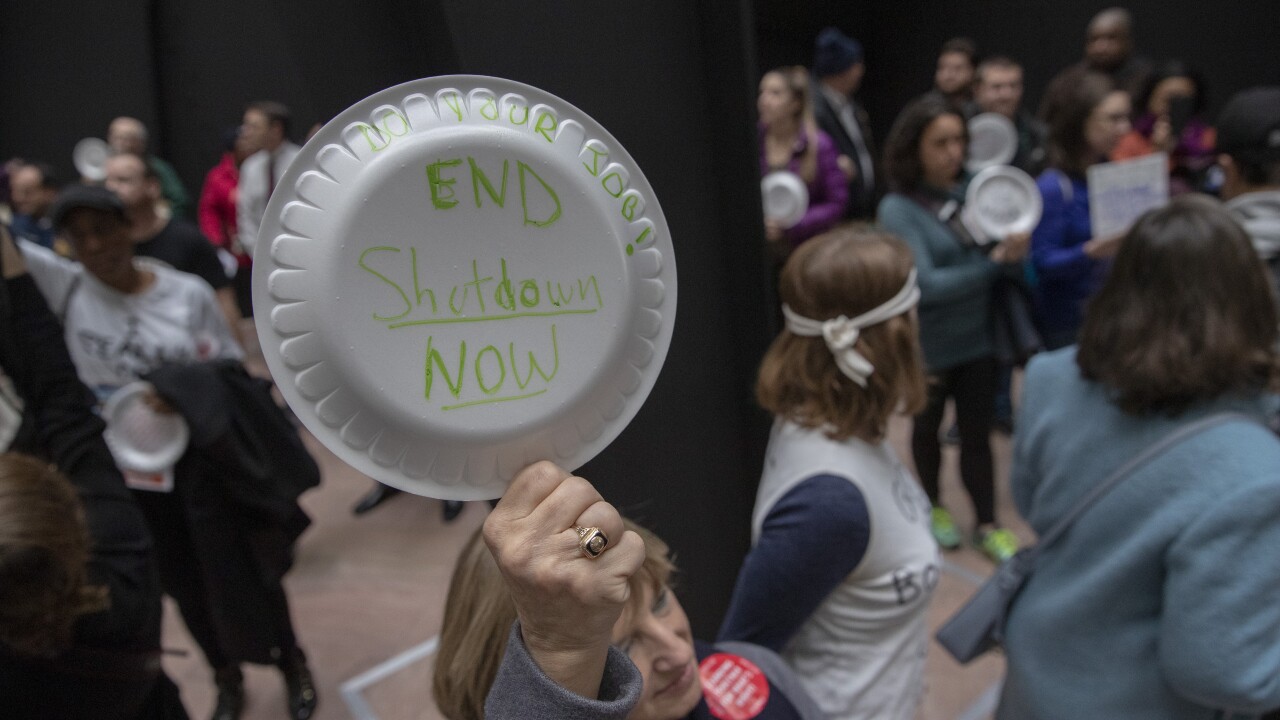
The question of what banks are doing to aid government workers shows how the industry is still struggling to rebuild its image following the crisis.
January 24 -

U.S. Commerce Secretary Wilbur Ross said unpaid federal workers could borrow to tide themselves over during the government shutdown rather than call in sick to earn a paycheck elsewhere.
January 24 -

Trade groups have filed paperwork supporting two Michigan credit unions facing ADA suits, but a similar suit against Domino's Pizza could cloud the issue.
January 24 -

Chris D’Angelo, the CFPB's associate director of supervision, enforcement and fair lending, is leaving the bureau after eight years to become a chief deputy attorney general in New York state.
January 24 -

There’s no reason for the central bank to prohibit nonbank financial firms from entering the payments system as long as appropriate rules are put in place to protect against risk.
January 24 -

EU states such as Belgium, Lithuania and Ireland are offering e-money institution, payments institution or banking licenses to fintechs, which can be passported across Europe, in anticipation of the U.K. losing its ability to do so after Brexit. But there is no cross-border deposit protection for European consumers holding accounts at EU banks with passported licenses.
January 24 -

Several new members of the House Financial Services Committee with backgrounds in housing could use their experience to address Chairman Maxine Waters' top agenda items.
January 23 -

When a Columbia University professor surveyed 1,000 payday loan customers, little did he know that the resulting research report would become a lightning rod in the drafting of rules for small-dollar lenders.
January 23 -
The Society for Worldwide Interbank Financial Telecommunication reports that its Global Payments Innovation system, which it launched two years ago, now handles more than a million payments a day.
January 23 -

Industry groups and lawmakers have joined bankers in insisting the agency develop a plan to resolve the paperwork problem before the partial government shutdown ends.
January 23 -

Rep. Patrick McHenry, R-N.C., the ranking member of the House Financial Services Committee, wants the panel to look into how Britain's move to leave the EU – which has rankled credit unions across the pond – is impacting the U.S.
January 23 -

The Florida bank sold $344 million of taxi-medallion and other loans in the fourth quarter, saying it was positioning itself for the future.
January 23 -
Rep. Patrick McHenry, R-N.C., the ranking member of the House Financial Services Committee, urged Chairwoman Maxine Waters, D-Calif., to prioritize certain "critical areas" in the new Congress.
January 23 -

Americans 50 and older make up a sizable portion of the U.S. population — 115 million individuals in 2018. While these consumers may not be the first to use mobile P2P apps, they represent a big payment opportunity because of their economic purchasing power.
January 23


