
Federal Reserve
Federal Reserve


-

In addressing systemic risks posed by fluctuating cryptocurrency values, the Federal Reserve and other central banks must acknowledge that quantitative easing has driven up the price of digital assets.
May 24 -

While cryptocurrencies could have benefits, they have “not served as a convenient way to make payments, given, among other factors, their swings in value,” said the head of the Federal Reserve. He also detailed imminent Fed research on a central bank digital currency.
May 20 -

Federal Reserve Vice Chair Randal Quarles has made it clear that banks failing to make the transition away from the benchmark rate could face supervisory consequences.
May 19 -

Financial institutions said they needed more time to weigh in on issues such as how they use artificial intelligence for fraud prevention and underwriting.
May 17 -

During the pandemic-induced lockdowns, the Federal Reserve loosened a rule requiring banks to cap certain savings withdrawals at six per month. Some banks have since dropped ceilings and associated fees, while others have stood pat.
May 17 -

Regulators around the world are exploring how to assess banks' exposures to climate change risks. But they'll have to tackle legal, economic and modeling problems that don’t have obvious solutions.
May 12 -

The central bank wants to adopt new rules to state clearly that merchants must have a choice of debit networks for card-not-present transactions.
May 7 -

The Treasury Department announced that Michael Hsu, a senior official at the Federal Reserve, would lead the national bank regulator until a Senate-confirmed comptroller is in place.
May 7 -

The Federal Reserve said its regional banks should consider whether nontraditional financial companies meet the requirements of certain federal statutes and present “undue” risk to the financial system before granting access.
May 5 -

More than a year into the pandemic, with the U.S. economy improving and consumers having paid down debt, bankers are finally loosening the reins in auto lending and credit cards.
May 5 -
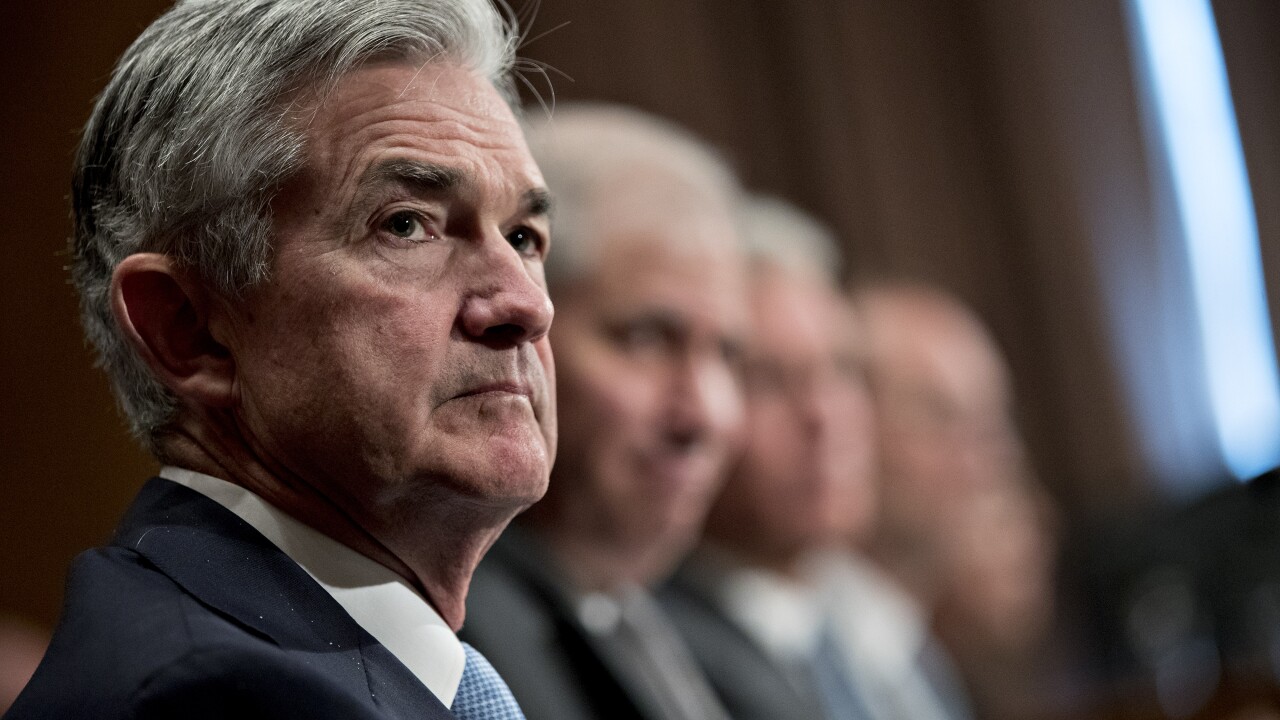
A senior White House economic aide said the decision on selecting the next central bank chief will come after a thorough “process.”
May 4 -

The head of the Federal Reserve appeared to support Congress’s expanding the scope of the Community Reinvestment Act to unregulated institutions, just as regulators weigh how to modernize the framework for banks.
May 3 -

Treasury Secretary Janet Yellen plans to name Michael Hsu, associate director of bank supervision at the Federal Reserve, to be the acting comptroller of the currency, according to The Wall Street Journal.
May 3 -

The Federal Reserve has kept interest rates low to reduce unemployment and to keep prices stable. But in “Engine of Inequality," Karen Petrou argues that its accommodative stance is actually making the wealth gap wider.
April 30 -

The Federal Reserve's top supervisory official, Randal Quarles, says regulators need to get a stronger grasp of digital currencies in order to supervise them. His comments Thursday follow reports that several large banks have started offering clients the ability to invest in bitcoin funds.
April 29 -

Shopkeepers and other establishments say banks' costs have fallen substantially in recent years but interchange prices have held steady since the Federal Reserve capped them in 2010.
April 29 -
Shop owners and other establishments say banks' costs have fallen substantially in recent years but interchange prices have held steady since the Federal Reserve capped them in 2010.
April 29 -

Federal Reserve Chair Jerome Powell is dismissing claims that loose monetary policy has led to rising home values and shrinking inventory and insists that the market is buoyed by creditworthy borrowers and investors.
April 28 -

The Federal Reserve and other central banks deciding whether to compete with private cryptocurrencies should heed the financial stability risks, such as expanding the economic power of governments and altering longstanding payments models.
April 26 -
The Federal Reserve and other central banks deciding whether to compete with private cryptocurrencies should heed the financial stability risks, such as expanding the economic power of governments and altering longstanding payments models.
April 21


