
Regulation and compliance
Regulation


-
What's the point of regulatory capital rules that ignore demonstrated problems, like unrealized losses? We need to rethink what banks' disclose to investors and regulators.
May 2 -

During this week's Federal Open Market Committee meeting, officials voted to lower the cap on the amount of Treasury securities that can roll off the central bank's books each month from $60 billion to $25 billion.
May 1 -

House Republicans held a subcommittee hearing on reforming bank merger M&A, laying the groundwork to counter Biden administration efforts to make it more difficult for mergers to be approved.
May 1 -
Top Federal Home Loan bank officials said they fear the Federal Housing Finance Agency will use supervision to further the goals of last year's report recommending reforms to the Home Loan Bank System.
May 1 -

The Bank of England set a date of March 2025 for local banks to establish operational resilience plans, Ant Group is using artificial intelligence to aid shopping, and more.
May 1 -

The Consumer Financial Protection Bureau is considering new rules covering the collection and sale of some consumer data. If it's not careful, the agency could be inadvertently assisting identity thieves.
May 1 -

A 50% growth in losses from check fraud last year is pushing bankers in Illinois to ask regulators for a joint supervisory guidance and tougher enforcement of large banks' "know your customer" compliance.
April 30 -

Toronto-Dominion Bank has taken an initial provision of $450 million in connection with U.S. investigations into its anti-money-laundering practices and said it expects additional penalties to come.
April 30 -

Consolidation has slowed since the pandemic, but UMB's agreement to buy Heartland Financial — the largest deal in three years — is one of several merger announcements in the past two weeks. Talks among other potential buyers and sellers are said to be picking up.
April 30 -

The failure of Republic First isn't a systemic threat or even a surprise. But the conditions that led to its failure are not all that unique and may foreshadow a secular rise in bank consolidation — one that policymakers can either embrace or resist.
April 30 -

In this month's roundup of top banking news: Navy Federal Credit Union officially launches its overseas banking program, Republic First Bank in Philadelphia falls to capital troubles and investor outrage, deeper looks at talks between Discover and Capital One and more.
April 30 -

Extensive partnerships with third-party service providers, fintechs and other partners are the banking equivalent of a supply chain, and bankers need to be clear-eyed about assessing the risk associated with them.
April 29 -

The Federal Deposit Insurance Corp. is arguing that Colorado has the right to establish an interest rate cap that all state-chartered banks must follow. Three industry groups are suing the state in an effort to stop its attempted crackdown.
April 28 -

Liberty Bank in Salt Lake City had been "structurally unprofitable" since 2008, according to its regulators. Experts criticized the FDIC for allowing the bank's demise to play out in slow motion.
April 25 -

The FDIC board debated and ultimately withdrew two separate proposals to address asset managers' control over banks, but acting Comptroller of the Currency Michael Hsu said he couldn't support either and called for more research and debate about how asset managers' control over banks impacts safety and soundness.
April 25 -
The state's comptroller of public accounts is one of several notable non-depositories with access to the Fed's payments system, along with the Chicago Mercantile Exchange and the Tennessee Valley Authority. So why do they have accounts while some neobanks don't?
April 25 -

The Federal Reserve's new proposal to lower the cap on debit card fees will drive up the prices consumers pay for other services, while forcing some banks out of the market entirely.
April 25 -

The store-branded card issuer is raising annual percentage rates and adding fees for paper statements to compensate for lost revenue. The Consumer Financial Protection Bureau's new regulation is scheduled to take effect on May 14.
April 24 -
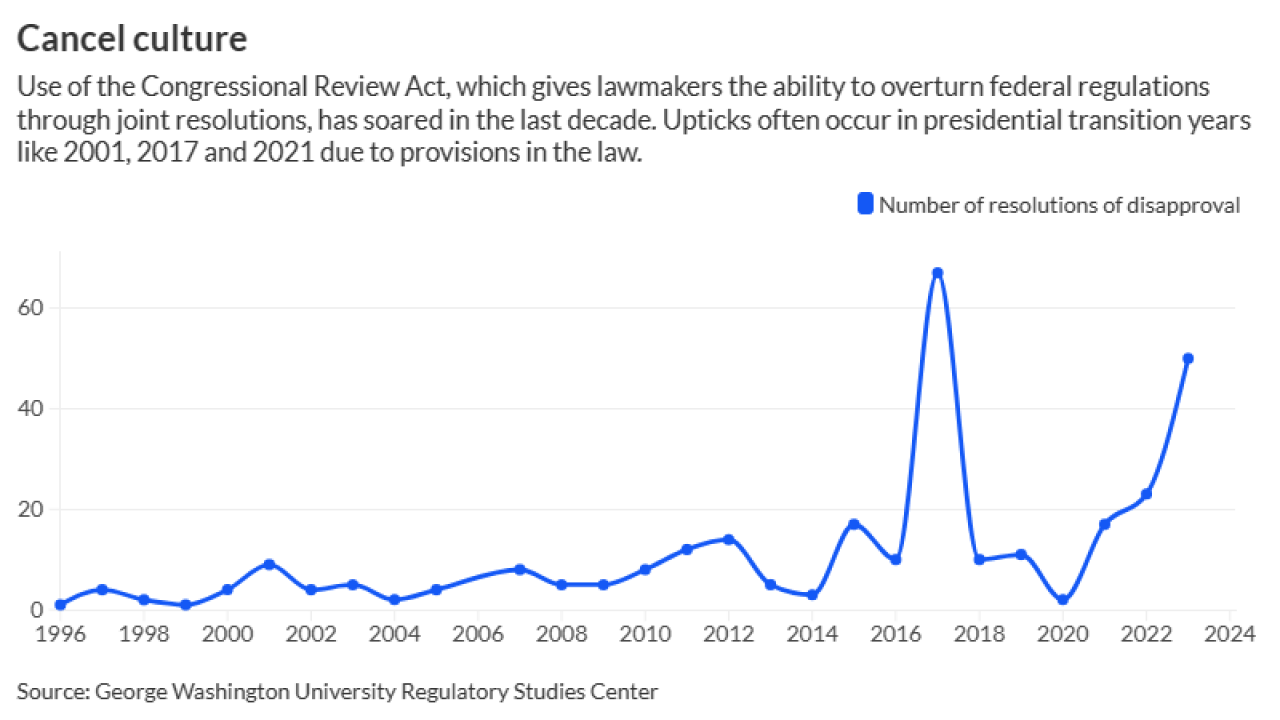
Congressional Review Act resolutions are ramping up ahead of the 2024 election cycle. Experts say that, although none are likely to become law, the resolutions are still powerful messaging and political tools.
April 24 -

An anti-ESG crusade in Texas exposes the degree to which conservative hype over companies' ESG policies has lost touch with the reality of the market, to the detriment of taxpayers.
April 24


