-
Banks are boosting their use of new machine learning to improve security risk, but securing international transactions presents a different set of challenges.
 August 20
-
The Consumer Financial Protection Bureau has moved to ban medical debt from appearing on credit reports, but its analysis relies on a sliver of consumer data from more than a decade ago.
August 20
-
For half a century, the Shadow Open Market Committee has been one of the Federal Reserve's sharpest critics. After years of seeing its public profile wither, the group is eyeing a return to prominence.
 August 20
-
The military-focused company, which operates an insurer and a $111.7 billion-asset bank, has tangled with regulators during Wayne Peacock's tenure. He will retire in the first half of 2025.
 August 19
-
Four companies are fighting CFPB enforcement actions by claiming the agency cannot be funded by the Federal Reserve, which has not been profitable since 2022. The consumer bureau calls the new legal theory "meritless."
 August 19
-
Even as quantum computers still can't break encryption, the banking industry has been preparing for more than a year to start switching to post-quantum cryptography.
 August 19
-
The job reductions come as the card network focuses on emerging markets, artificial intelligence and other nascent technology over transaction volume.
 August 19
-
Royal Bank of Canada's onetime chief financial officer was allegedly in a relationship with an executive in the bank's corporate treasury group for more than a decade. A court filing offers a remarkably detailed look at how the bank alleges it played out.
August 19
-
U.S. Eagle Federal Credit Union said it plans to acquire Southwest Capital Bank in a transaction slated to close next year. It would help the buyer expand its cannabis banking operation.
August 19
-
Federal Reserve Gov. Christopher Waller says the central bank is tracking research on financial stability risks related to payments, as well as blockchain and crypto developments.
August 19
-
It has never been more important for banks, particularly those over $10 billion of assets, to establish ironclad data quality, governance and control standards. The failure to do so will have cascading negative consequences.
August 19 Ludwig Advisors
 -
Lorch started as the marketing director at First Internet Bank, the first online-only bank, at its launch. Few Americans had internet access so it wasn't a sure bet the bank would survive. She's still there, now as the president.
 August 19
-
While financial institutions continue to recover from the widespread tech disruption, executives are asking what effective fix-it plans might look like during future events.
 August 16
-
The planned Bay State deal comes two months after the Minneapolis-based Thrivent said it plans to merge a credit union it controls into a new industrial bank.
 August 16
-
The once-worsening trend of consumers struggling to pay their credit card bills keeps stabilizing, new data from card issuers showed this week. The improved picture comes amid other signs that consumers aren't slowing their spending.
August 16
-
Vice President Kamala Harris outlined a raft of populist economic proposals in her first major economic speech since securing the Democratic presidential nomination, including some aimed at lowering housing costs and boosting supply.
 August 16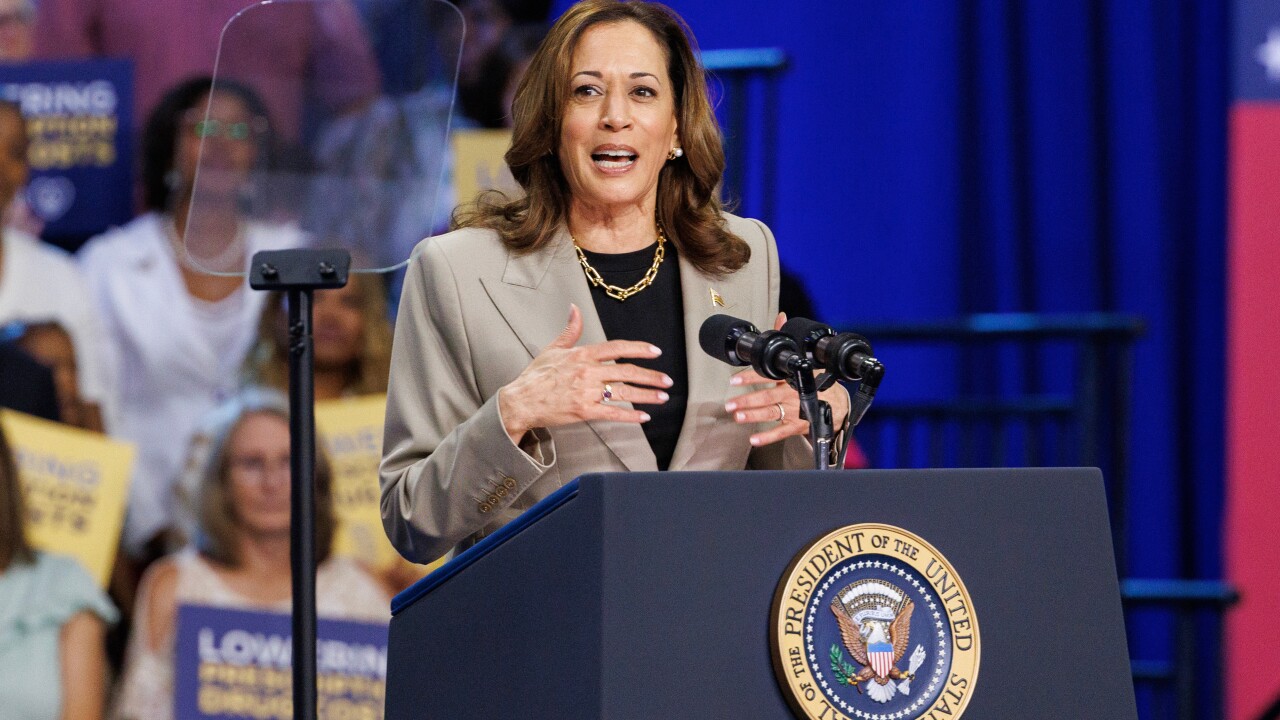
-
Nonbanks that rely on sponsor banks to underpin their financial services may assume that "going direct" is safer after the Synapse bankruptcy. But banking-as-a-service middleware has its merits.
 August 16
-
Regions Bank hires next corporate banking group leader from within; Detroit CU names its first-ever woman CEO; United Community raises its quarterly dividend; and more in this week's banking news roundup.
August 16
-
The Swedish institution is adding savings accounts to its signature buy now/pay later service as it plots an IPO. Analysts say it will be a struggle to go against U.S. institutions.
August 16
-
An amicus brief filed in a lawsuit challenging newly finalized implementing regulations for the Community Reinvestment Act argues that the court was chosen because plaintiffs believe the court is more likely to rule in their favor.
 August 16


