

As federal watchdogs step back from regulating "Buy Now, Pay Later" loans, state authorities are stepping in. This week, the attorneys general from California and several other blue states joined the fight.


As banks start giving work formerly done by humans to artificial intelligence programs, questions about legal and ethical implications arise. The time to impose values on, and set limits for, the technology is now.

-

Federal Reserve Gov. Christopher Waller says the central bank is tracking research on financial stability risks related to payments, as well as blockchain and crypto developments.

-

The once-worsening trend of consumers struggling to pay their credit card bills keeps stabilizing, new data from card issuers showed this week. The improved picture comes amid other signs that consumers aren't slowing their spending.

-
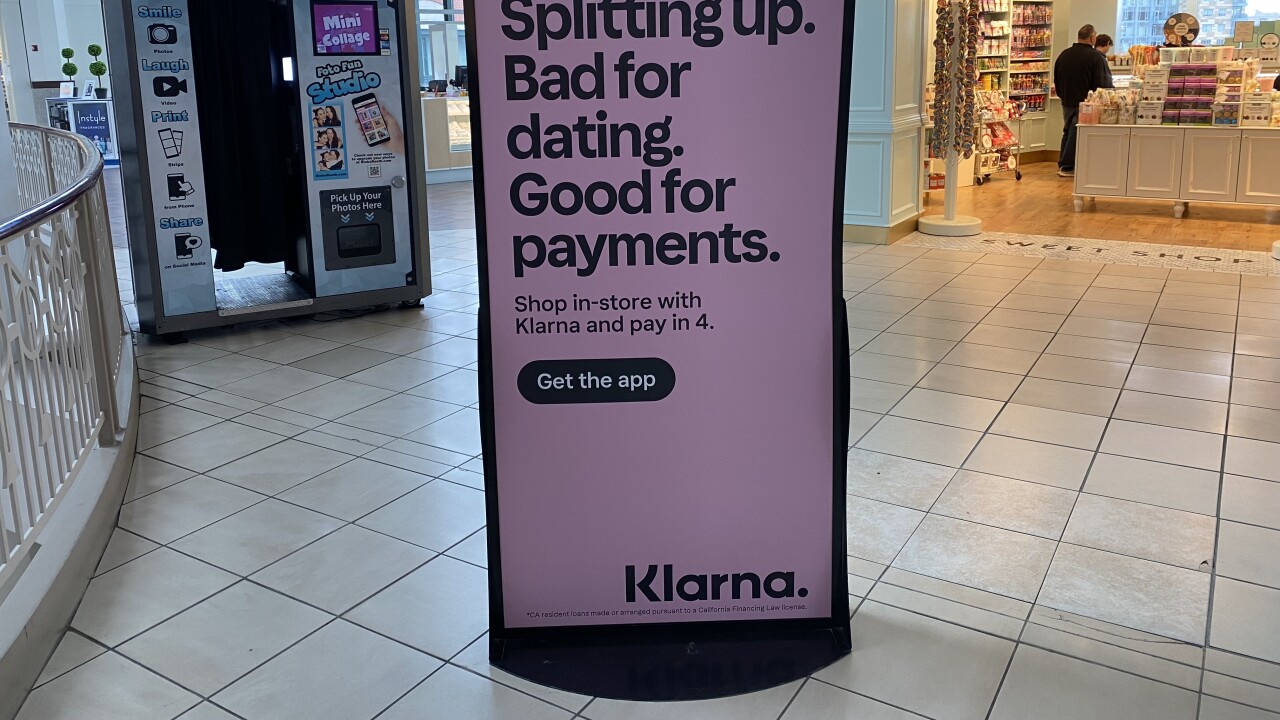
The Swedish institution is adding savings accounts to its signature buy now/pay later service as it plots an IPO. Analysts say it will be a struggle to go against U.S. institutions.


A near-collapse of the global software vulnerability database exposed critical weaknesses that could leave banks unable to track cyber threats.


-
Profits soared at First Republic Bank in San Francisco thanks to lending growth in several categories and its expansion in wealth management.

-
Banks are slowly warming up to the idea of open APIs, essentially tools that allow banks to easily connect with others, but BBVA's Shamir Karkal says that they will likely also push banks to modernize their core systems.

-
Boston Private Financial Holdings appointed its bank president, George Schwartz, to the newly created position of chief executive of its private banking group.


-
![“We are delaying the opening of ... [the] comment period until we have some certainty on what the current overall situation is,” said FHFA Director Mark Calabria.](https://arizent.brightspotcdn.com/dims4/default/339407b/2147483647/strip/true/crop/4182x2352+0+0/resize/1280x720!/quality/90/?url=https%3A%2F%2Fsource-media-brightspot.s3.us-east-1.amazonaws.com%2F24%2F4f%2F09d186a142899167373b7d4166b7%2Fcalabria-mark-bl-031820.jpg)
FHFA Director Mark Calabria said the health crisis will complicate the release of a proposal establishing new capital requirements for Fannie Mae and Freddie Mac.
-

The temporary foreclosure moratorium on loans backed by HUD, Fannie Mae and Freddie Mac comes after lawmakers and housing advocates had pushed for steps to avoid consumers getting booted from their homes.
-

The pandemic has upended staffing plans, sparked concerns about servicers’ capacity to handle the expected crush of missed payments, and even raised questions about their ability to stay afloat.

![“We are delaying the opening of ... [the] comment period until we have some certainty on what the current overall situation is,” said FHFA Director Mark Calabria.](https://arizent.brightspotcdn.com/dims4/default/d447028/2147483647/strip/true/crop/4182x2352+0+0/resize/1440x810!/format/webp/quality/90/?url=https%3A%2F%2Fsource-media-brightspot.s3.us-east-1.amazonaws.com%2F24%2F4f%2F09d186a142899167373b7d4166b7%2Fcalabria-mark-bl-031820.jpg)


This year, 90 banks made American Banker's 12th annual Best Banks to Work For ranking. The leaders of these institutions share how they keep their employees happy.


Treasury Secretary Scott Bessent said he expects negotiations with trading partners over tariffs to conclude by the end of the year but acknowledged that talks with China had not yet begun.


-

The real threat is from undercapitalized banks, and regulators must require large banks to have enough capital to eliminate that threat.

-

Moody's decision to downgrade some banks' bond ratings isn't great news, but life will go on. The bigger and more difficult problem is shoring up U.S. sovereign debt ratings in the long-term.

-

Many small-business lenders have less than 18 months to figure out how to gather and report on an extensive array of data.


-
The activist investor HoldCo Asset Management alleges that Comerica and Fifth Third used a "flawed" process to arrive at a $10.9 billion merger agreement. On Tuesday, a Delaware judge said she will hold a hearing to determine if the banks omitted material information in their public disclosures.


-
The New York Stock Exchange disclosed the news on Monday of the sudden passing of its head of International Capital Markets.


-
Bank of Marin Bancorp in Novato has sold a big chunk of low-yielding securities, replacing them with investments that should produce significantly more income.


-
The Supreme Court won't consider Todd Harper and Tanya Otsuka's case alongside a similar one involving the Federal Trade Commission when it hears oral arguments in early December.


-
The Federal Reserve, Office of the Comptroller of the Currency and Federal Deposit Insurance Corp. issued a final rule Tuesday that softens leverage demands for the biggest and most systemically risky banks and lowers the community bank leverage ratio to 8%.


-
New guidance from the Office of the Comptroller of the Currency released Monday afternoon would streamline Bank Secrecy Act exams for community banks. The agency issued a separate request for information on consolidation and contracting power among core service providers.


- Daily BriefingDelivered Every WeekdayIdeas that impact your business delivered to your inbox every day.
- TechnologyWednesday, ThursdayThe latest industry developments from digital banking to cybersecurity to AI.
- PaymentsDelivered Every WeekdayAn early-morning roundup of important headlines from the past 24 hours.
- Best of the WeekFridayThe most important and widely read stories from the previous week.

Federal Reserve Gov. Stephen Miran argues that banks holding excess reserves are keeping the central bank's balance sheet bigger than it should be, and suggested that regulatory changes could help bring those reserves down.

Travis Hill's nomination to lead the Federal Deposit Insurance Corp. was recommended favorably by the Senate Banking Committee to the full Senate Wednesday morning in a 13-11 party-line vote.


The 23rd annual ranking of women leaders in the banking industry.
-
 Partner Insights from Tenemos


-
 Sponsor Content from Equifax
 -
 Partner Insights from Cash Connect
 - Partner Insights from Cash Connect
- Partner Insights from Cash Connect

