
Fraud
Fraud


-

State Treasurer John Chiang says that Wells Fargo is keeping patterns of abuse hidden from view by resolving customer disputes through private arbitration.
August 23 -

After 20 years of working with a clunky, time-consuming 3-D Secure authorization method for online purchases, the wheels are finally in motion to get the upgraded 2.0 version in place for merchants and banks, granting access to more data for spotting fraud.
August 20 -

CO-OP Financial Services is currently pilot testing the new data-driven tool with credit unions in its shared branching network.
August 17 -

A mortgage fraud scheme involving fake employment records, initially thought to be contained to Southern California, is occurring statewide, Fannie Mae said in a new fraud alert.
August 9 -

The former Trump campaign chair got $16 million in mortgages from The Federal Savings Bank. His trial is shedding new light on what the bank's CEO allegedly received in return.
August 7 -

A legal battle is being waged between a U.S. bank and its insurer over the insurer’s refusal to pay out on a cyber policy, in the wake of hacks on the bank which led to a loss of over $2.4 million. The case flags the problems of insurance in the fast-moving world of digital security.
August 3 -

Wire and other payments fraud affected a record number of businesses last year, and the FBI is warning in particular about real estate scams.
August 1 -

The roster of potential witnesses at the trial of President Trump's former campaign manager includes current and former employees of Citizens Financial Group, Banc of California and The Federal Savings Bank.
July 27 -

To make informed decisions about fraud prevention, merchants must understand the current fraud landscape, customer expectations, and the risks and rewards associated with internal and external fraud prevention approaches, writes Bernardo Lustosa, partner, co-founder and COO of ClearSale.
July 25 -

Several firms are touting tools to help financial institutions bank legal marijuana-related businesses, an industry expected to yield $10 billion in retail sales this year.
July 24 -
Tokenization as a technology is suitable to support multiple payment use cases via a single system, ensuring emerging commercial models and the ability to adapt to new requirements are not constrained by an inflexible security framework, writes David Worthington, vice president of payments at Rambus.
July 19 -

Beyond offering a buzzworthy new payments app or automating exhausting mortgage applications, for example, traditional payment providers and fintechs need to ensure that their business is resilient against increasingly sophisticated cybercrime and ready for a hyperconnected world, writes Malte Pollman, CEO of Utimaco.
July 17 -

Fallout from the Equifax breach is coming into clearer focus as more companies begin pinpointing its effects over the last several months.
July 11 -

Once regarded as a safer option for consumers, BOPIS (buy online and pick up in store) has now joined the ranks of targets that cybercriminals are learning to exploit. It comes down to correctly identifying the shopper, writes Ryan Wilk, vice president of customer success at NuData Security.
July 10 -

A new court filing suggests that Stephen Calk was named to a 13-member economic advisory team in 2016 in exchange for approving a $9.5 million loan to former campaign manager Paul Manafort.
July 6 -

Nonlisted encryption solutions are designed for easier deployment, but often lack many of the key attributes of PCI-listed point-to-point encryption products, writes Ruston Miles, founder and chief strategy officer of Bluefin.
July 3 -

Phone-based customer service opens opportunity for voice phishing, or "vishing," and other types of attacks linked to card not present transactions, according to Rafael Lourenco, an executive vice president at ClearSale.
July 2 -

As data breaches mount in the "Equifax era," CFOs have a broad vision of enterprise data that can prove helpful in mitigation, according to Lauren Ruef, a research analyst for Nvoicepay.
June 29 -
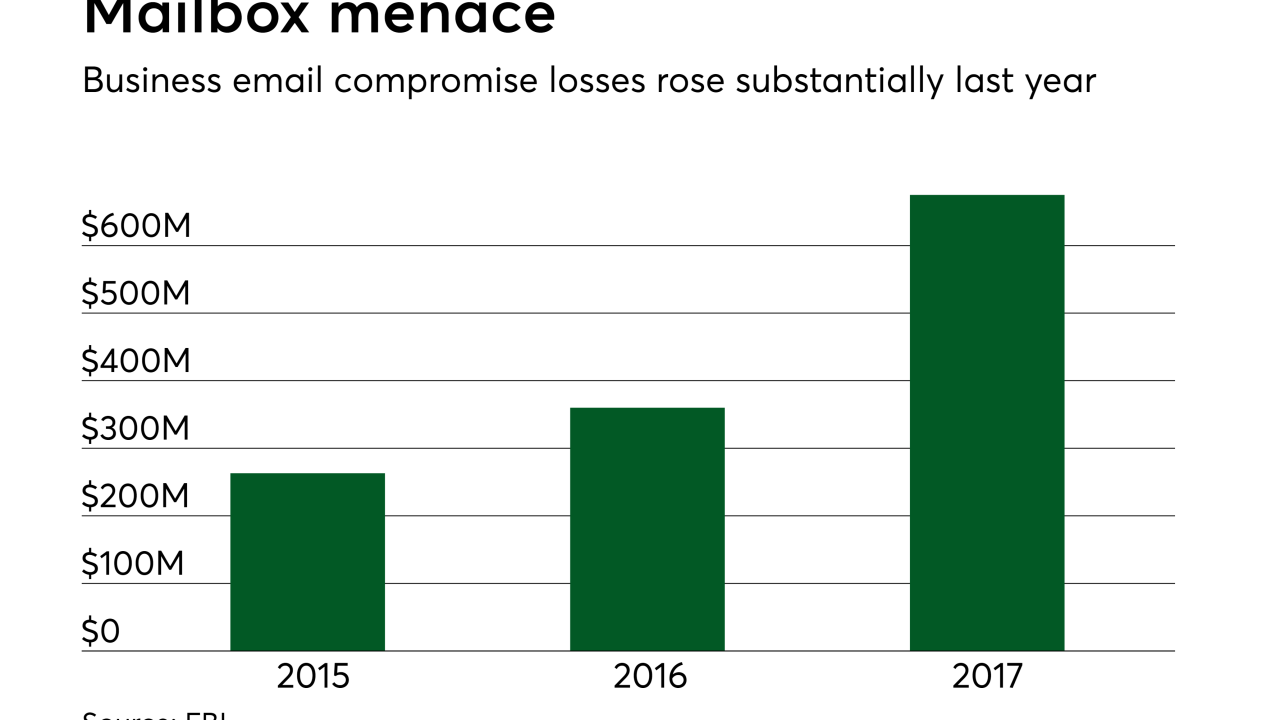
Payments fraud from business email compromise, or BEC, occurs when scammers use phishing tricks and email to fool businesses into making fraudulent payments to perceived suppliers. Experts suggest newer factors are accelerating the trend.
June 27 -

Judge says agency should not exist; the Fed says the largest banks are “strongly capitalized” and could withstand a severe crisis.
June 22


